Anyone trying to win large accounts knows this scene. There is a name that has been sitting in the CRM for two years: a big company, the customer who on its own would change your revenue. The deal is still open, quarter after quarter.
“They’re still evaluating.” “Let’s talk again after the budget.” “They’ve asked for another quote.” Nobody has ever said no. And nobody has ever worked out what it has cost so far.
Owners and sales directors of very different companies tell me this in almost the same words: “We spend months chasing companies that end up going nowhere, and we don’t find out until it’s too late.”
You can hear the frustration. You can’t see the cost: it doesn’t show up anywhere. That is exactly why it goes on.
When you set out to win large accounts, your first margin lever is not price and not discount: it is the list. The wrong account costs you twice. While you chase it, and afterwards, if you are unlucky enough to win it.
In short
- The cost of accounts that never close does not appear in the accounts: it is spread across payroll, services and travel. That is why nobody measures it.
- A large account chased for two years can easily cost around €70,000. Four of them are worth more than €3 million of revenue at the average margins of Italian companies.
- With large accounts, deals rarely end in a no: between 40% and 60% end with no decision at all. The account never dies, and you keep paying for it.
- The wrong large customer can cost you margin even after it signs.
- Selection happens before you spend: four questions, a budget and an exit date for every account.
Why the cost of unclosed accounts stays invisible
An Italian income statement follows article 2425 of the civil code, which groups costs by nature: materials, services, staff, depreciation. International standards also allow grouping by function. Neither has a line per customer, let alone per deal.
So two years spent chasing a large account end up spread across the usual lines. The salesperson’s salary sits in staff costs, the sample in materials, the trip in services. Every euro is there, but none of them carries the account’s name.
The CRM doesn’t help either. It records the deal, the stage, the expected value and a close date that slips every quarter. It has no field for what the deal has cost you so far. And in a company, what has no field doesn’t exist.
What goes into two years of chasing
If you try to rebuild it, the bill for a large account that never closes almost always has the same lines:
- Sales time, which on an important name is never small.
- Engineering, preparing technical offers, variants and custom drawings.
- Samples, prototypes and line trials, often at your expense.
- Travel and visits, because a large customer expects to be visited.
- The owner’s or sales director’s time, brought in “to send a signal”.
- The opportunity lost: the accounts nobody worked on, because the time went here.
The last line is the most expensive, and you will never see it on an invoice.
A worked example
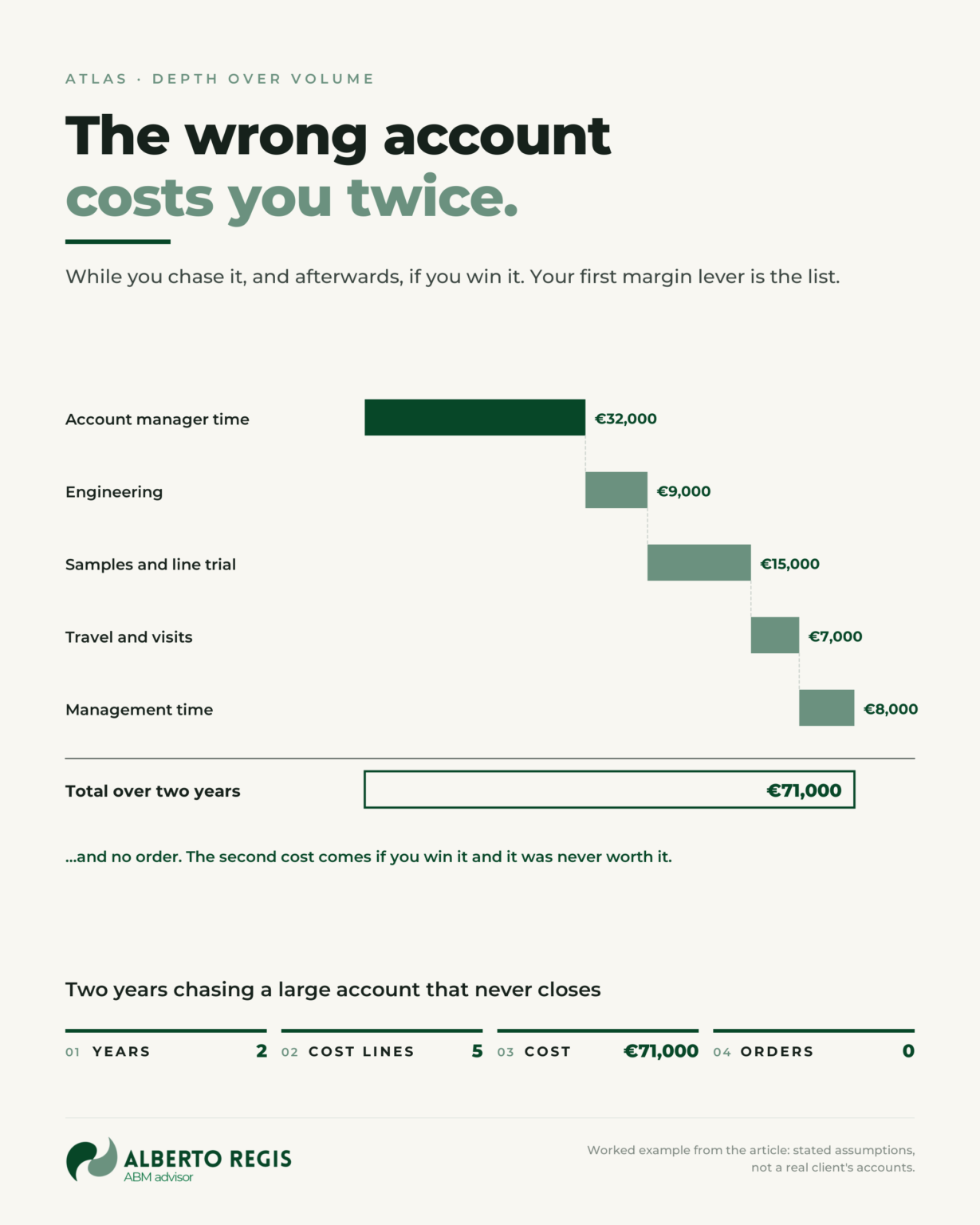
Here is a conservative estimate for a manufacturer with revenue between €20 million and €100 million. These are assumptions, not a client’s figures: replace them with your own. The order of magnitude usually holds.
| Item | Assumption | Cost over two years |
|---|---|---|
| Sales time | 20% of a key account manager who costs the company €80,000 a year | €32,000 |
| Engineering | 3 technical offers of 60 hours each, at €50 an hour | €9,000 |
| Samples and line trial | one trial batch and a day on site | €15,000 |
| Travel and visits | 10 visits at €700 each | €7,000 |
| Senior management time | 8 days of the owner or sales director, at €1,000 a day | €8,000 |
| Total | €71,000 |
Seventy-one thousand euros for one account doesn’t sound like a disaster. The point is that hardly anyone chases just one. With four accounts like this over two years, the figure reaches €284,000.
Now translate it into revenue. According to Cerved’s 2025 balance-sheet observatory, the gross operating margin of Italian companies in 2025 was 8.8% of revenue for small firms and 8% for large ones.
At those margins, producing €284,000 takes between €3.2 million and €3.5 million of revenue. Three million more just to get back where you started. That is why selection is your first margin lever.
Why nobody stops chasing
If the arithmetic is that clear, why do companies keep going? There are three reasons, and none of them is laziness.
Large customers almost never say no
For their book The JOLT Effect, Matthew Dixon and Ted McKenna analysed around 2.5 million recorded sales conversations. Between 40% and 60% of deals, Dixon explains, are not lost to a competitor: they are lost because the customer doesn’t decide.
And less than half of those non-decisions come from attachment to the status quo. The rest comes from fear of making a mistake. A customer afraid of getting it wrong doesn’t say no: they ask for another quote.
So the account never dies. It stays in the pipeline, with a close probability nobody has the nerve to lower, and it keeps costing money.
Whoever chose the account is also the one judging it
In 1976 the psychologist Barry Staw asked 240 business students to allocate research funds between two divisions of a company. Those who had personally chosen the division that then did badly put even more money into it in the second round.
He called it escalation of commitment. The same happens in companies. The salesperson wanted the account, or the owner did. After two years, closing the file means admitting those two years are gone.
So there is another offer, another visit, another sample. “We’ve put so much into it already.”
A big name in the pipeline is convenient
There is also a reason people mention less often. An important name in the pipeline is reassuring: in meetings it fills out the numbers, in front of shareholders it looks good. Removing it means showing a smaller pipeline. A truer one, too.
Sometimes the customer knows it. Many suppliers put it to me like this: “These days they only call us to make up the numbers in tenders, and then they decide on price anyway.” You are the third quote, the one that keeps the incumbent honest.
Choosing the accounts that deserve your next two years is a human decision. The relationships that decide a deal are not in the data, as I explained in Account-Based Marketing Is Not What the Software Industry Sold You.
The case: €200,000 for every customer signed
A company that designs and runs real-time tracking systems for warehouses had everything going for it: a proven product, hundreds of projects worldwide, a huge market. Contracts worth one or two million euros. And one problem: it was signing two new customers a year.
Once we ran the numbers, every customer signed was costing around €200,000 in sales costs and 18,000 kilometres of travel. Between a tenth and a fifth of the contract was gone before it was signed. From first contact to customer, conversion was 0.3%.
There were five mistakes, and they compounded: cold meetings, with people who didn’t decide, in the wrong accounts, without knowing their priorities, without an offer built for them. The third was the most expensive. For them, the right account was “anyone with a warehouse”.
We changed the list first, then the message. One sector to start with: glass and ceramics. Twenty interviews with decision-makers in that sector. Then sixty accounts chosen one by one, not pulled from a database.
Those sixty accounts produced five meetings and one contract. Conversion went from 0.3% to 1.7%, almost six times higher. And across the table there were no longer warehouse managers, but CEOs and CFOs.
The full case is on the Use case – Logistic page. For another example of how listening in the field changes the list before the message, read the warehouse logistics case.
The wrong large customer costs you even when it signs
There is a second cost, and it comes after the signature. Robert Kaplan, Harvard professor and co-creator of the balanced scorecard, spent years studying how much each customer really earns. With V. G. Narayanan, in a 2001 article, he described the whale curve.
It works like this: the most profitable 20% of customers generate between 150% and 300% of profits. The middle breaks even. The bottom 10–20% destroy between 50% and 200%. And the loss-makers can include the very largest customers.
In manufacturing it is easy to see why. Large customers ask for volume discounts, customisation, dedicated stock, 120-day payment terms, audits and endless samples. If you chose one only because it was big, you risk working hard to earn very little.
“I need one account that changes my quarter on its own.” I understand. But one good quarter followed by three weaker years is not a good deal. If it then grows too heavy in your revenue, you also have a dependency problem.
Winning large accounts: how to choose before you spend
Selection is not a list of big companies. It is the work that decides where your time goes before you start spending it. It is the first step of my method: in one recent project, six accounts were left out of around 480 candidates.
Four questions before you open an account
- Can you name the person who signs? Not the purchasing department: the person who decides, and what they really care about. Usually money, time and risk, more than technical specifications.
- Is there a reason to change now? An industrial plan, a shrinking margin, a new market. It is often written in the annual report: small data that says a lot. Without one, the customer is in no hurry, and you pay for the wait.
- Is the current supplier disappointing someone who matters? If the decision-maker is happy, you are there to be the third quote.
- Can you show they would sell more, or risk less, with you? Not that your product is better: that their income statement improves.
If you answer no to two of the four, stop before you spend. It doesn’t mean giving up forever: it means that account isn’t ready today. Or you aren’t.
A budget and an exit date for every account
Every large account should start with two numbers written down: how much you will spend, and by when you expect a signal. Not a request for a quote: a conversation with the decision-maker, or a concrete step on their side.
Every account is a bet, after all, and a serious bet has a maximum stake. I wrote about it in The bet inside 1-few ABM.
If the date arrives and the signal doesn’t, the account stops or goes on hold. Walking away is not losing: it is stopping paying. Deciding it at the start, with a cool head, is the only way not to leave the decision to hope.
Keep score, account by account
You don’t need software. A spreadsheet with the lines of the worked example and one column per account is enough, updated every quarter: sales hours, engineering hours, samples, travel, senior management time.
The first time you fill it in, the conversation in the boardroom usually changes. It is no longer about what the account is worth if it closes, but about what it costs every month it doesn’t.
Where the one-to-one work begins
In my work this step is called Account Strategic Intelligence: a dossier on each candidate account, built on its financials, organisation and market. It may conclude the account is worth it. Or that it isn’t, which is often the answer that saves the most.
Only the accounts that pass deserve a one-to-one programme: that is where time spent becomes an investment.
Frequently asked questions
How much does it cost to win a large account?
It depends on the sector and the length of the deal, but the sum has to be done on every account you chase, not only on the ones you sign. In the warehouse case, before selection, every signed customer cost around €200,000 in sales costs.
When should you stop chasing an account?
When the date you set arrives without the signal you were waiting for: a conversation with the decision-maker or a concrete step on their side. The date is decided before you start, not after two years.
How many large accounts can you work on at once?
Not many. In one-to-one programmes, a full-time person usually looks after one to three accounts. Six accounts worked properly beat thirty chased in turns.
How do you measure the cost of an account that doesn’t close?
With a simple spreadsheet: for each account, sales and engineering hours, samples, travel and senior management time. Update it every quarter and compare it with the expected margin, not with revenue.
Before you chase the next large account, check whether an account-based approach fits your company at all. Four questions, a few minutes.
Is ABM right for your business? →And if you’d like to talk it through, write to me.
Sources
- Italian civil code, article 2425, content of the income statement (in Italian).
- BDO, Presenting operating expenses under IFRS 18: by nature, by function, or both?
- Cerved, Osservatorio Bilanci 2025, reported by Teleborsa, 31 July 2026 (in Italian).
- Matthew Dixon and Ted McKenna, The JOLT Effect, Portfolio, 2022; interview with Matt Dixon on CustomerThink, October 2022.
- Barry M. Staw, Knee-deep in the big muddy: a study of escalating commitment to a chosen course of action, Organizational Behavior and Human Performance, 1976.
- Robert S. Kaplan and V. G. Narayanan, Measuring and Managing Customer Profitability, Journal of Cost Management, 2001; summary of the whale curve on Wikipedia.