The bet inside one-to-few
Account-based marketing’s middle tier is sold as a question of budget. It is really a wager on timing.
When account-based marketing acquired its name in the early 2000s, it also acquired a shape.
Three tiers: one-to-one for a handful of strategic accounts, one-to-few for small clusters, one-to-many for a programmatic long tail. The taxonomy was an accounting device. It answered a question about allocation — how much attention a given marketing budget can buy per account — and it answered it sensibly. Nobody can run twenty individual programmes with four people.
Two decades on, the three tiers are read differently. They have become a ladder of maturity. Software vendors present them as stages, with the implication that a company begins in the long tail, graduates to clusters, and eventually earns the right to one-to-one. Consultancies sell the climb. Marketing directors describe their programmes by the rung they occupy.
The slippage is quiet and almost universal, and it has consequences, because a cost model and a maturity model recommend entirely different behaviour. A cost model tells you what you can afford. A maturity model tells you what you should aspire to. Only one of them is a strategy, and it is not the second.
The confusion matters most in the middle.
One-to-few is where the majority of European industrial vendors end up, usually for the stated reason that one-to-one is unaffordable. What they believe they are buying is a proportional trade: roughly half the depth for roughly a fifth of the cost, spread across five or eight accounts instead of one. It sounds like a reasonable piece of arithmetic. It is also the wrong description of the transaction, because what a one-to-few programme actually buys is a single hypothesis, placed on several tables at once.
The economics of the tier come from sharing. The research is shared, the narrative is shared, the value case is shared, most of the assets are shared; only the surface is varied. That sharing is not a compromise on quality.
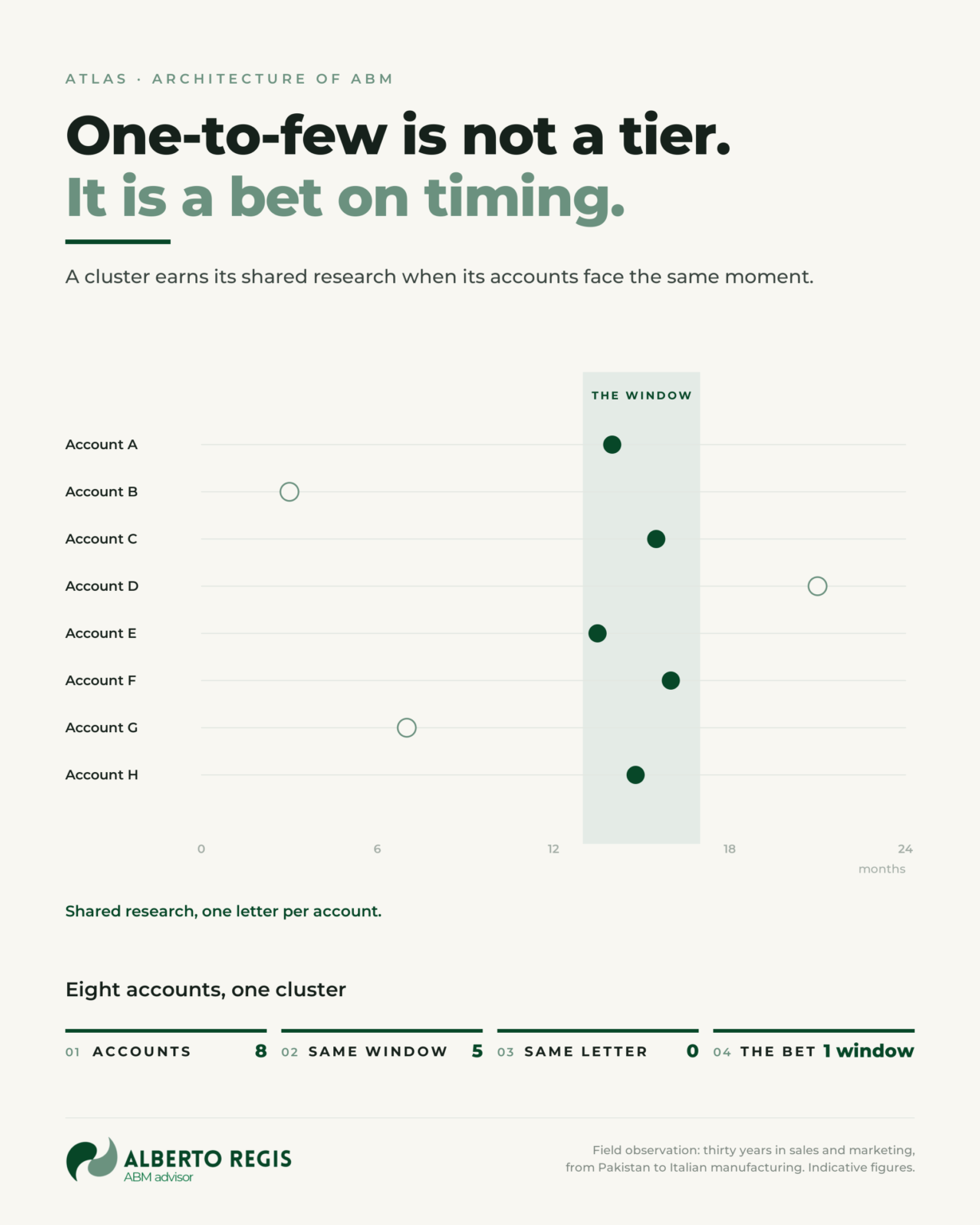
It is the entire source of the cost advantage, and it has a condition attached. For the programme to work, one proposition has to be simultaneously true, relevant and timely for every account in the cluster. Not similar. True at the same time. This is a strong claim about the outside world, and it is made before any money is spent. One-to-one makes a much weaker one: it assumes only that a particular company has a particular problem, and it tests that assumption in dialogue with that company, continuously, correcting as it goes.
One-to-few assumes that five companies have converged on the same problem in the same quarter, and it has no equivalent correction mechanism, because the personalisation it offers is shared by construction. You cannot revise the hypothesis for one account without unpicking the economics for all of them.
Described that way, the middle tier is not a diluted version of the top tier. It is a different discipline, with a harder entry requirement. One-to-one demands resources. One-to-few demands that you be right in advance.
The requirement would be easy to satisfy if clusters formed along the lines most firms use to build them. They do not. The standard method is firmographic: sector code, revenue band, headcount, geography, sometimes installed technology. These variables describe what companies are. The hypothesis needs to be about what they are deciding, and the two correlate far less than the tidiness of a spreadsheet suggests.
Consider five manufacturers of hydraulic components in northern Italy, comparable in size, comparable in product, comparable in export mix. On any segmentation model they belong together. In practice one is in the middle of a generational handover and will sign nothing before the succession is settled.
One has just lost a captive customer in Germany and is cutting discretionary spend. One is eighteen months into an ERP migration that has consumed every hour of its technical management. One is under a private-equity earn-out with a horizon that makes any payback beyond two years irrelevant. One is genuinely available. A shared campaign addresses the fifth and annoys the other four, at a cost carried by all five.
In European manufacturing the deeper similarity tends to run along the supply chain and the technology base rather than along the classification code. Two companies with different sector codes and different revenue can be identical in what is keeping their operations director awake, because they sell into the same three customers and depend on the same casting supplier.
Two companies that look like twins on paper can be in entirely different financial weather. Firmographics catch the twins and miss the real pair. There is, though, one variable that reliably produces synchrony, and it is worth naming because it is the exception that makes the tier work: an external deadline that applies to everyone at once.
Regulation with a date attached does this. So does the expiry of a framework contract, the qualification cycle of a shared OEM customer, or a supplier’s end-of-life announcement on a component that a dozen firms have designed into their machines. When the European machinery regulation replaces the old directive, every manufacturer placing equipment on that market faces the same compliance date, whatever their revenue band.
That is a cluster. It was created by a calendar, not by a segmentation exercise, and it will dissolve the moment the date passes.
Where the calendar does not do the work, the consequences are not symmetrical with those of a failed one-to-one programme, and this is the part that most planning ignores. A one-to-one programme built on a mistaken reading of an account fails visibly and cheaply. The client does not recognise the problem described, says so in some polite form, and the reading is corrected in the following conversation.
The error carries information; the account is usually still there afterwards. Marketing has spent money and bought a better map. A one-to-few programme built on a mistaken hypothesis fails invisibly. Five accounts go quiet at once. Silence across five accounts looks like a result but contains nothing: it does not distinguish a wrong hypothesis from adequate execution against the wrong list, or from good work delivered a quarter too early.
There is no control group, because the whole point of the tier was that everyone received the same thing. Worse, the failure is public in a small way. In industrial markets the technical managers of competing firms meet at trade fairs and sit on the same standards committees.
A message that lands as irrelevant with five companies in one supply chain is remembered as a characterisation of the vendor rather than of the campaign. So the tier concentrates risk at precisely the moment when firms believe they are spreading it. Five accounts is not diversification if the same assumption underwrites all five. It is one position, held five times.
None of this argues against one-to-few. It argues for a different test before entering it, and the test is about the accounts rather than about the vendor’s budget. The first condition is a shared trigger with a date: not a shared profile, not a shared pain in the abstract, but an event that forces a decision in a known window for every account in the group. If the trigger cannot be written on a calendar, the cluster is a list. The second is structural similarity in the buying group, which means that the decision sits with the same functions and, more importantly, that the veto sits with the same function, across all the accounts.
This is where the Personafication System earns its keep: the honest test is not whether the personas resemble each other but whether they converge — whether the same person, in the same seat, carries the same risk in each company.
Where one account’s decision is owned by operations and another’s by finance, a single narrative will satisfy neither, and the shared asset becomes a compromise document addressed to nobody. The third condition is transferability of proof. The evidence that persuades one account must be usable with the next without being re-argued; a reference case that works only after a two-hour explanation of context is a one-to-one asset wearing a one-to-few label.
Three conditions, all of them about the world rather than about the marketing department. They have an awkward property: they can be checked cheaply, in a few weeks of disciplined account research, and they frequently fail. That is the uncomfortable part. A firm that runs the test honestly will often find that its intended cluster of eight is in fact two accounts that are genuinely synchronised, three that are worth pursuing individually on their own timetable, and three that belong on a nurture list until something changes.
The resulting programme is smaller, slower and considerably more likely to work than the one that was budgeted. Where the test passes, the opposite conclusion holds with equal force: if five accounts really are moving together, running five separate programmes is not rigour but waste, five times the cost for a depth that adds nothing, and the discipline to keep them in one programme is worth more than the discipline to separate them.
The question that opens most ABM planning sessions is how many accounts the firm can afford to treat individually.
It is the wrong question, inherited from a cost model that was never meant to be read as an ambition. The right one is narrower and harder to answer: how many of these accounts are deciding the same thing at the same time?
Where the answer is five, one-to-few is not a compromise between rigour and reach but the correct instrument. Where the answer is one, the tier does not save money; it converts a manageable risk into a correlated one, and defers the discovery of the error until the budget has been spent.
The middle rung of the ladder, in other words, is not a place to stand while waiting for resources. It is a bet on the synchrony of other people’s calendars. Firms that treat it as a bet, and price it accordingly, tend to win it. Firms that treat it as a stage of maturity have already stopped looking at the accounts.