I hear it in almost every first conversation: "What used to bring us leads doesn't bring anything anymore." Trade shows, campaigns, newsletters, the salesperson who picks up the phone. They worked for years. Today they bring names, but rarely the ones that matter.
Faced with the decline of B2B lead generation, I see two reactions. The first is to push harder: more email, more contacts, more automation, and now AI writing a thousand messages a day.
The second is to throw it all out and chase the new formula, which today is usually called Account-Based Marketing (ABM).
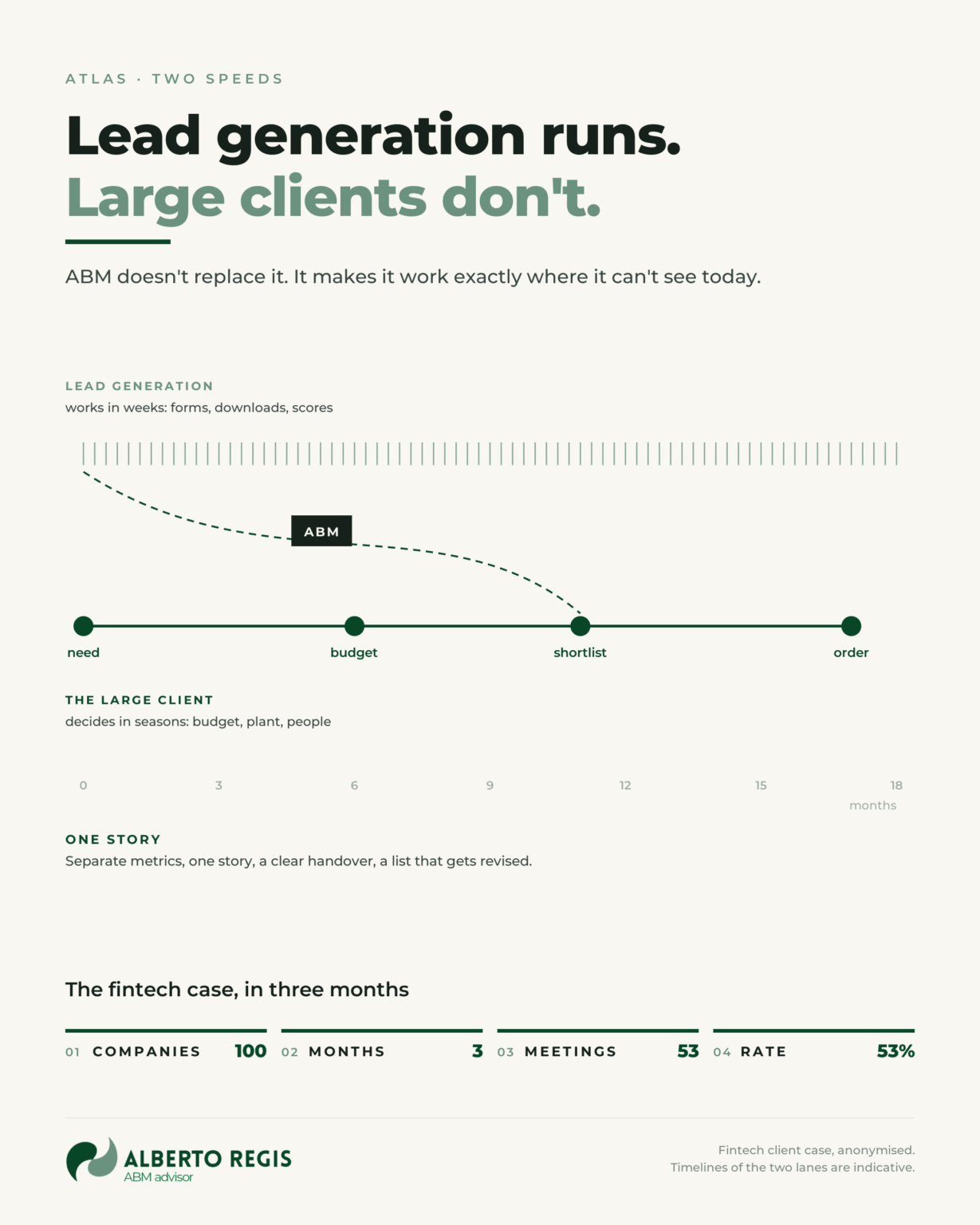
Both are wrong, for the same reason: lead generation works at a different speed from the one your big clients decide at. ABM doesn't replace it. It makes it work exactly where it can't see today.
Here I'll explain why, when a handful of contracts make your year, it pays to go slow on a few clients, and how to make the two work together.
The big client decides before you call
Lead generation is built to catch the people who raise their hand: who downloads a document, fills in a form, stops by the stand. The trouble is that when a large company raises its hand, much of the game is already over.
The 2025 6sense study of B2B buyers, published in November 2025, shows it:
- 94% of buying groups rank their shortlist of suppliers before contacting any of them;
- the first contact with a seller happens when the buyer is already 61% through the journey;
- in nearly eight cases out of ten it is the buyer who reaches out, not the seller;
- 77% of the time the buyer buys from the supplier that topped that early ranking.
In earlier editions 6sense already noted that cold calls and cold email weigh little: the buyer waits until ready, and ignores the rest in the meantime.
If you sell plants, custom components or multi-year supply, this means something concrete. By the time the request for quotation lands on your desk, someone has already decided who starts ahead.
If until then you were only a name in a database, you enter the tender to set the price for the others. "These days they only call us to make up the numbers" is another line I hear often.
Lead generation tells you who raised their hand. About the months when the preference formed it knows nothing, and in there it can't take you.
More messages, less listening: the limit of B2B lead generation
Pushing the volume, unfortunately, makes things worse. Of 632 B2B buyers surveyed by Gartner, 73% actively avoid suppliers who send irrelevant outreach.
In the follow-up survey published in March 2026, 67% prefer to buy without going through a salesperson at all.
AI has made writing and sending a message almost free. Reading it costs the recipient the same time as before, and time is the scarcest thing a CEO or a head of procurement has.
When anyone can send a thousand "personalised" emails, personalisation becomes noise. The recipient learns not to open.
There is also a design limit. Lead generation measures single people, while large purchases are decided by a group, larger than most assume.
In its 2024 report on B2B buying, Forrester found that 86% of purchases stall along the way, and that 81% of buyers are dissatisfied with the supplier they chose.
According to another Forrester analysis, fewer than 1% of the leads generated reach the bottom of the funnel. A lead is not a customer, and an interested person is not a group that has decided.
Why go slow, on a few big clients
If your company turns over between 20 and 100 million euros and sells complex solutions, a few contracts probably decide the year. That is a risk, the one rarely said out loud:
"If my largest client decided to leave tomorrow, I don't even want to think about what would happen." But it is also a concrete opportunity: one new client, the right one, is enough to change a company's trajectory.
Going slow on a few clients means matching the pace at which those clients decide. A large industrial purchase follows the client's investment cycle, not your campaign calendar.
The preference forms over the months when the client reads, asks around, compares, argues internally. If you want to be there, you have to be there early and consistently, talking about their problems and not your catalogue.
A job like this isn't done on three hundred companies. It's done on five, ten, sometimes twenty. You read their financial statements and industrial plans, and work out who decides and what each of them has at stake.
Then you follow the signals: a new plant, a change at the top, a supplier that let them down. It is slow because each client is a market of its own.
In return it compounds: every month you know a little more about that client, and they about you.
Slow does not mean still. It means choosing where to put your time, the resource everyone is short of, instead of spreading it over leads that aren't worth the same.
How ABM helps B2B lead generation
ABM and lead generation work at different speeds and, put together, cover what neither covers alone. Here are five points where ABM makes lead generation more useful.
It weights your leads
If an engineer at one of your chosen accounts downloads a datasheet, that download is worth more than the other three hundred that week. It is a signal from a company you already know.
You know who else decides there and what they care about. That lead leaves the automated sequence and enters the programme built for that account.
It tells your sales team where not to go
"My salespeople run all day, but at the end of the month I don't really know what we produced." With a short list of chosen accounts, you separate the leads to call today from the ones that can wait for the newsletter.
It sharpens the content
An article written for the people who decide in six specific companies is sharper than one written for "the market". And it also attracts the companies that look like those six, which usually have similar problems.
It fills the gap after first contact
Sometimes lead generation gets you the ten minutes with the right person, and then the conversation dies there. If those ten minutes happen inside an account you have studied, you already know what second step to propose, and to whom.
It gives trade shows a point
Before a trade show you can know which people from your chosen accounts will be there, and prepare for each an invitation that speaks to their problem. The stand stops waiting for whoever walks by.
A case: 53 meetings across 100 companies in three months
For a fintech selling to large Italian companies we worked on 100 accounts, with no relationship to start from. The first two months went into reading their financial statements, not writing to them.
The salespeople were the same ones who had written without reply before. What changed was the starting point of the message: no longer the product, but what each company's balance sheet said.
In three months, 53 of the 100 companies agreed to a meeting. In the same market, the published benchmarks for traditional outbound sit between 2% and 5%.
In another programme, the commercial cost of signing a new client fell from about €200,000 to a small fraction, with a €2M contract signed in 120 days.
These are not isolated cases, though the industry's numbers should be read with care. In Momentum ITSMA's 2024 survey of more than 300 B2B marketers, 81% say ABM returns more than their other initiatives.
That figure is reported by the marketers themselves, in research sponsored by an ABM software vendor. But the direction is clear.
ABM and lead generation together: the practical rules
Think of your company as a two-speed engine. The wide gear, lead generation, speaks to the market: website, trade shows, campaigns, content, catalogue. It makes you findable and keeps the base of small and mid-sized clients alive.
The narrow gear, ABM, works on a few chosen accounts and builds the preference long before the tender. To run them together, four rules are enough, as long as you keep them.
Separate metrics
Lead generation is measured in leads, cost per lead, opportunities. ABM is measured differently: how many of the people who decide in the chosen accounts know you, at what level the conversation runs, how many opportunities open.
If you judge ABM after three months with lead-generation numbers, you kill it just as the first doors open. Even when the first meetings come early, the real opportunities usually arrive between the sixth and the eighth month.
One story
The website, the trade show and the personal message to the chosen account's technical director must say the same thing. If marketing talks product and the account programme talks about the board's problems, the client sees two different companies.
A clear handoff
Decide in advance what happens when a lead comes in from one of the chosen accounts: who takes it, by when, with what next step. It is the simplest rule, and the one that breaks most often.
A list you revisit
The signals from lead generation also tell you which companies are warming up. Once a quarter it is worth asking whether the chosen accounts are still the right ones.
Where to start
You don't need software, or a multinational's budget. You need a decision: which five or ten clients would change your company's year?
If the answer doesn't come at once, that is the first job to do, before any campaign.
If you want to see the method on a real account, read the business case: a €2M contract signed in 120 days, starting from zero.
Read the case →And if you'd like to talk it through, get in touch.
Sources
- 6sense, 2025 B2B Buyer Experience Report, November 2025; data summarised at CustomerThink.
- Gartner, press release of 25 June 2025 and press release of 9 March 2026.
- Forrester, The State of Business Buying, 2024, press release of 4 December 2024.
- Forrester, Saying Goodbye To MQLs.
- Momentum ITSMA, 2024 Global Account-Based Marketing Benchmark, sponsored by Demandbase.