
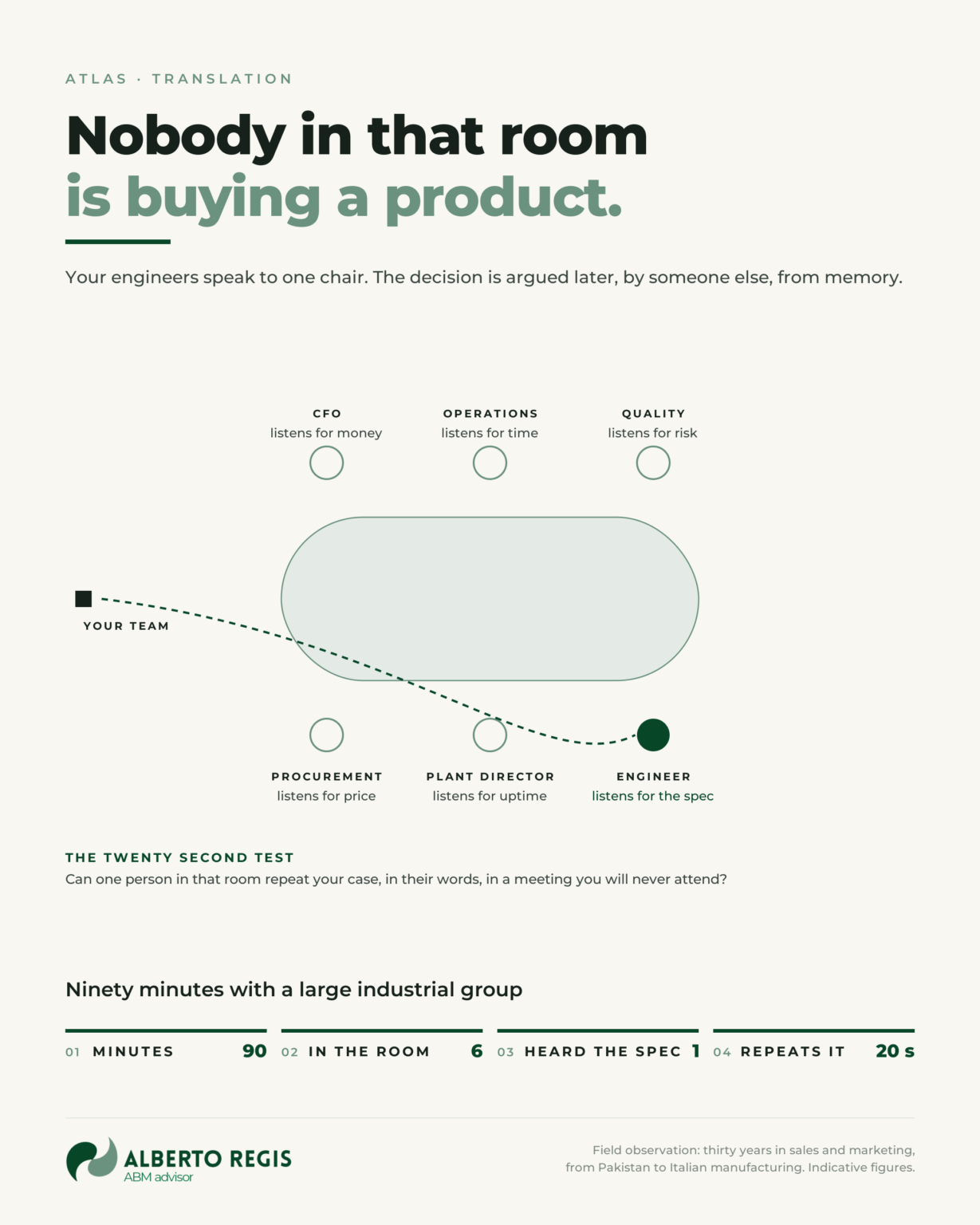
Your engineers explain the product beautifully. Nobody in that room is buying a product.
The meeting went well. That is usually the first clue that it did not.
You had ninety minutes with a large industrial group. Your best technical people were in the room, and they were superb. Tolerances, materials, process control, the test data. Precise, honest, genuinely impressive work.
Everyone nodded. Somebody said this was very interesting. And then the decision went quiet, in the way these decisions always go quiet.
An owner described this to me more sharply than I could: “We are outstanding engineers, and when we speak we describe the product in the finest detail. But when we need to engage a C-level, that approach does not work. We keep talking about how the product is made instead of what impact it has on their business, so we end up boring them, or being treated as a commodity supplier.”
Boring them, or being treated as a commodity. Those are the only two outcomes available when the translation is missing.
The person deciding is not evaluating your product
This is the part that takes a while to accept, because it feels almost insulting to the work.
The senior person in that room is not judging whether your technology is good. They assume it is good, or you would not be sitting there. Your technical excellence got you the meeting. It will not get you the decision.
What they are actually evaluating is what happens to them if they choose you. What changes in their numbers. What could go wrong, and what it would cost if it did. Whether this choice makes their year easier or riskier.
So while your engineers explain how the product is made, the decider is quietly trying to answer a completely different question, and receiving no help with it at all.
Meanwhile your competitor, whose product is very probably worse than yours, has answered that question in one sentence. That is often the whole story of why you lost.
The rule: every specification must finish the sentence
There is a simple discipline that fixes most of this, and it costs nothing.
Take any technical claim you make, and force it to finish this sentence: “which means that you…”.
Five microns of precision, which means that… what? If you cannot complete it, you have given the room a fact and made them do the work of turning it into meaning. Most rooms will not do that work. They will just file you under “technically competent supplier” and move on.
Completed properly, it sounds like this. Five microns of precision, which means fewer rejected parts downstream, which means fewer unplanned line stops, which means roughly two hundred thousand euros a year that stops leaking out of your operation.
Notice what happened. The specification did not disappear. It simply stopped being the argument and became the proof.
Here is the test I use.
If your sentence ends in a unit of measurement, you have stopped one step too early. Keep going until it ends in money, in risk, or in time.
The three currencies
Senior people in large industrial organisations buy in three currencies, and almost never in the one your engineers prefer.
The first is money, and it is the most obvious. Cost removed, output gained, waste stopped. Always a number, always their number rather than an industry average.
The second is time. Weeks saved on a launch, a plant back in production a day earlier, a bottleneck removed before the peak season.
The third is risk, and it is by far the most powerful of the three. Somebody is putting their name on the decision to bring you in. What you are really selling, at that level, is the confidence that this choice will not become their problem in eighteen months. Continuity of supply, traceability, certifications, what happens at three in the morning when a line goes down. That is not paperwork. That is the actual purchase.
Most SMEs with excellent products speak fluent specification and barely speak risk at all. It is the single biggest translation failure I see.
Do not simplify. Relocate.
There is a bad version of this advice, and I want to be clear that I am not giving it.
Nobody is asking you to dumb down your technology, and nothing damages credibility faster than an owner who suddenly cannot answer a technical question about his own product. The detail is your evidence. It is why you are believable.
The move is not to delete the detail. It is to relocate it.
Lead with the consequence. Hold the specification one layer behind it, ready for the moment the technical evaluator asks, because they will ask, and that is exactly when your depth becomes an asset instead of a wall.
Different seats in that room need different languages. The engineer needs your process. The finance director needs your impact. The plant manager needs your reliability. It is the same truth, told three ways, and you need all three ready before you walk in.
The twenty second test
Here is where translation quietly becomes strategy.
You will not be in the room when the real decision is made. Somebody inside the company will argue for you, in a meeting you will never attend, using whatever words they happen to remember.
So the honest test of your message is not whether it impressed the room. It is whether one person in that room can repeat it, correctly, twenty seconds at a time, with no slides in front of them.
If your value needs your deck to survive, it will not survive.
When we won the Regis account, the chief executive who ended the matter with “just pay Regis” had never seen a technical specification of ours.
He had been told, by people inside his own business, what our work would change for them. Years earlier, in Pakistan, a fifty five million dollar contract went the same way. The cabinet members who signed it off were not evaluating asphalt technology. Everyone they trusted had already understood what it meant for them.
This week
Take the specification sheet you are proudest of. Beside every line, write “which means that you…”. Do not stop until each line ends in money, risk, or time, in your buyer’s own numbers. You will be uncomfortable with how many lines you cannot finish, and those are the lines your buyers have been quietly ignoring for years.
That exercise alone will change your next meeting.
If you want the full method rather than the exercise, I have written it down.
👉 Ask for the free white paper, then book a free thirty minute masterclass with me. We will take one real capability of yours and translate it together, into the language of the person who signs.
Your technology is not the problem. It has simply never been translated for the person holding the pen.