
The Market of One: What One-to-One ABM Really Is
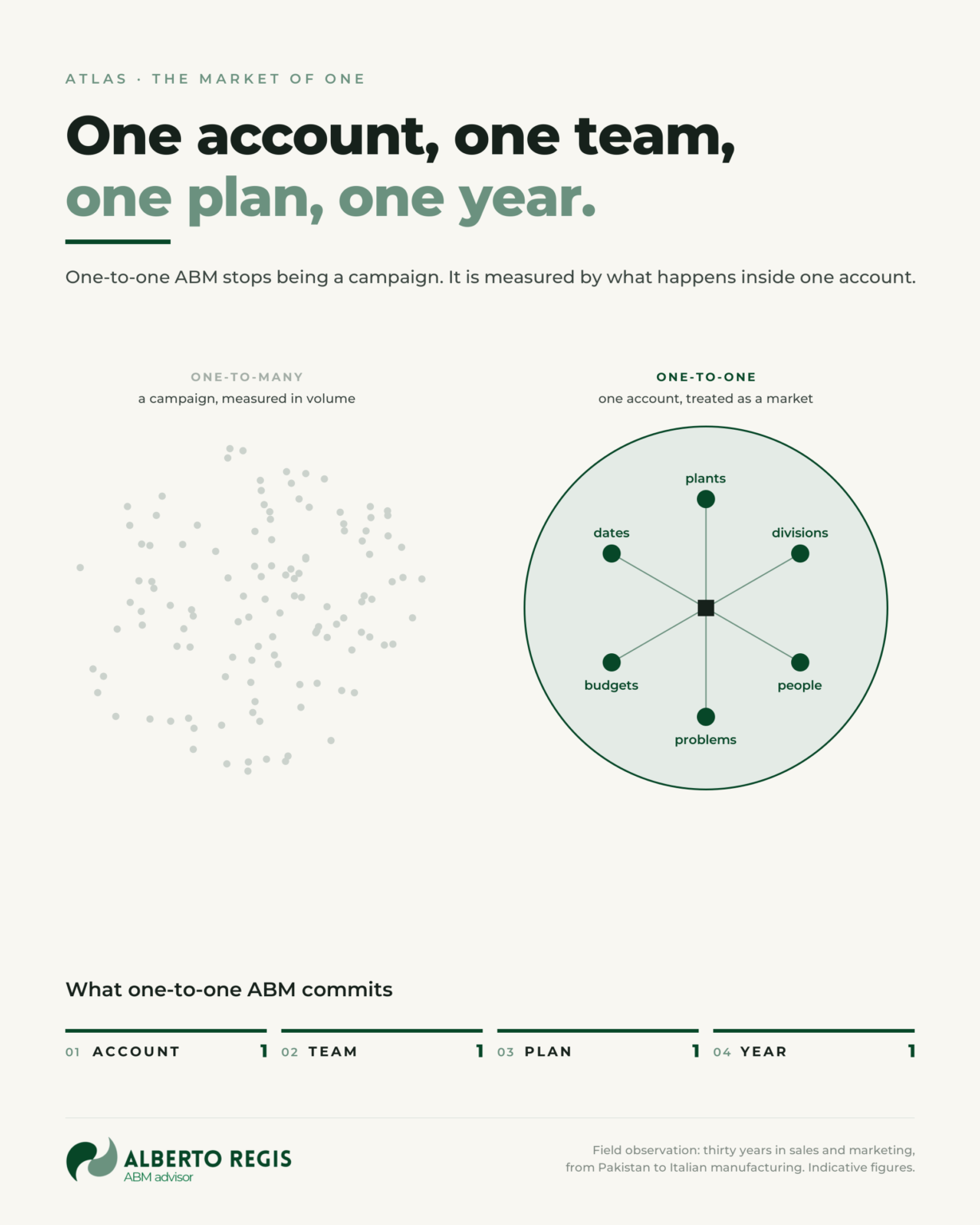
One account. One team. One plan. One year of your best attention.
That is one-to-one ABM, stated at its most literal. And already the word campaign has stopped fitting.
A campaign reaches many. This reaches one. A campaign is measured in volume. This is measured in whether a single account said yes.
Everything strange about one-to-one ABM follows from that one substitution. The unit is no longer the audience. It is the account. A single, named, specific company you have decided to win.
Three kinds of ABM, and only one that earns the name
ABM comes in three recognized forms. The industry knows them as one-to-one, one-to-few, and one-to-many. Bev Burgess, who coined the term at ITSMA, called them strategic, lite, and programmatic. They differ in one variable: how many accounts one program serves.
That variable looks minor. It is not. It changes what the word account means in each.
One-to-many runs against hundreds of accounts at once. No program can truly know hundreds of companies. So in practice it treats them as a segment with better firmographic filtering. The account becomes a row, not a market.
One-to-few is honest about the compromise. It handles a small cluster of similar accounts together. Better than a segment, but still a cluster. The unit is the group, not the single company.
Only one-to-one makes the account literal. One program. One account. Nothing shared, nothing clustered, nothing averaged.
This is why the founding phrase — a market of one — is only ever literal here. In one-to-few it is nearly true. In one-to-many it is a slogan. In one-to-one it is the plain description of the work.
The three are not intensities of one thing. They are three different relationships to the word account. Only one keeps its promise.
The economics that look insane
Now the part that stops most companies before they begin. One-to-one ABM is economically irrational by every rule of ordinary marketing.
Marketing is trained on efficiency. Reach the most people for the least cost. Spread the budget to lower the risk. Never bet the quarter on a single outcome.
One-to-one breaks all four rules on purpose. It reaches one company. It spends a campaign’s resources on that one. It concentrates the risk instead of spreading it.
To an efficiency mindset this is madness. It is madness — inside the wrong question. The efficiency question is: how many can I reach with this budget? One-to-one asks a different question entirely.
Is this specific account worth a year of my best work? Not many accounts. This one.
The question is not about reach at all. It is about concentration.
That logic is not marketing’s. It belongs to concentrated investing. A private equity fund does not buy a little of everything. It studies one company deeply and commits.
The return does not come from spreading the bet. It comes from being right about a single one. One-to-one ABM is that posture, applied to acquisition. A concentrated bet on an account you have judged worth it.
When the unit is one, selection becomes everything
Concentration changes where the risk lives. Spread across a thousand leads, one bad lead costs almost nothing. Concentrated on one account, one wrong choice costs the whole program.
So the decision that matters most is made before any work begins. Which account? Get that right and good execution compounds. Get it wrong and flawless execution is wasted on a prize not worth winning.
This inverts where marketers usually spend their care. Most energy goes into execution — the message, the creative, the channels. In one-to-one, execution is downstream of a harder act. The judgment of which single account deserves the concentration.
And judgment of that kind begins with refusal. To choose one account is to decline every other. The list of accounts you will not pursue is the strategy. One-to-one starts with a no said to almost everyone.
This is the discipline most organizations cannot sustain. Saying no to a plausible account feels like leaving money on the table. It is not. It is refusing to dilute the one bet that concentration depends on.
What it actually requires
People assume one-to-one ABM requires a large budget. It does not. It requires three things that are far scarcer than money.
The first is selection discipline. The nerve to choose one account and refuse the rest. The willingness to be judged on a single outcome. Most marketing structures are built to avoid exactly this exposure.
The second is a kind of knowledge you cannot buy. Not population data — that describes the many and none. Deep, specific intelligence about this one account. Its strategy, its pressures, its people, its unspoken imperatives.
This intelligence sits in small, dense sources. A financial statement read for pressure, not compliance. A phrase repeated in an earnings call. The review a departing employee left, the thing said once in a meeting.
None of it scales. All of it, on one account, is decisive. This is the raw material one-to-one runs on. Attention paid to the particular, where competitors paid none.
The third is patience, because the timescale is long. Complex industrial decisions form over a year or more. The outcome is usually settled before any formal process opens. One-to-one does its work in that long, quiet stretch.
It builds standing inside the account before there is anything to sell. It earns relationships with the people who will decide. It arrives early, and stays, and asks for nothing yet. That patience is a strategy, not a delay.
The problem of measuring one
One-to-one ABM breaks the instruments marketing uses to prove itself. You cannot report a conversion rate on a single account. There is no funnel, no cohort, no statistical curve. There is one outcome, months or years away.
This unsettles organizations that trust only what they can count. But the absence of a dashboard is not the absence of signal. The signals are simply qualitative, and you must read them.
A meeting granted. A question that shifts. A tone that warms. A door opened that was shut.
These tell you whether reputation and relationships are forming. They are the leading indicators of a decision not yet made. Reading them takes judgment, not a report. It is the same judgment the whole discipline runs on.
So one-to-one demands a rare tolerance from leadership. The willingness to fund a year of work measured in signs, not numbers. To trust a judgment before the outcome confirms it. This tolerance, more than budget, is what makes it possible.
Where marketing stops being marketing
Do all this and something odd happens to the categories. The line between marketing, sales, and service dissolves.
In ordinary marketing the customer is an object. A target, an audience, a recipient of the message. You act on them; they receive. The direction of the relationship is one-way.
One-to-one does not work that way. You study the account so closely and adapt so completely that it becomes almost a partner. What you produce looks less like a campaign than like unsolicited consulting.
You are not marketing at the account. You are thinking alongside it, about its problems, in its terms. The word marketing barely covers what this is. It is closer to being useful to someone before they asked.
This is where systems thinking becomes practical, not decorative. The account is not a company with a buyer at the top. It is an ecosystem of interdependent people. Influence runs through their relationships, not down the org chart.
To win the account you address the system, not a contact. The buying committee is six to ten people, by Gartner’s count. Each arrives with different information and its own reason to say no. The decision is made in the friction between them.
One-to-one is the only ABM with the resolution to work at that level. You cannot map a human system across five hundred accounts. You can barely do it for one. Which is exactly why it is done for one.
Who actually runs it
The operating model follows from the unit. One account cannot be served by the usual assembly line. Marketing generates, sales converts, service retains — that division assumes volume. At the scale of one, the handoffs make no sense.
One-to-one is run by a small, dedicated team around a single account. The same people who study it also engage it. Intelligence, message, and relationship live in one place. Nothing is thrown over a wall, because there is no wall.
This is why it cannot be industrialized without ceasing to be itself. Assembly lines exist to process many units cheaply. One-to-one has one unit and refuses to cheapen it. The model is a workshop, not a factory.
Why almost no one really does it
Given all this, most companies that claim one-to-one ABM are not doing it. They are running one-to-few and calling it one-to-one. Or one-to-many with a short list. The label is common; the practice is rare.
The obstacle is not technical difficulty. It is renunciation. Real one-to-one asks you to give up things that feel like safety.
You give up scale, and the comfort of large numbers. You give up the dashboard that makes activity look like progress. You give up the statistical cover of many small bets. You stake the outcome on one act of judgment, in public.
Most organizations cannot tolerate that exposure. So they dilute back toward volume, where no single choice can be blamed. The dilution feels prudent. It is the quiet abandonment of the only thing that made one-to-one work.
When it is the right instrument
None of this makes one-to-one universally superior. It is not better ABM. It is ABM for a specific class of bet.
It fits where a single account is worth an enormous amount. Where winning changes the trajectory of the business. Where the deal is large, strategic, and slow. Where losing is expensive enough to justify a year of attention.
For most of a company’s accounts, this is overkill. One-to-few or one-to-many will serve them well. The mistake is not choosing the lighter forms. The mistake is calling them one-to-one, and expecting its results.
Used for the right account, nothing else competes with it. It is the only form that can win a defended, high-value account against incumbents. Because it is the only one that treats that account as what it is.
Not a segment. A world of its own, worth understanding completely.
The market of one
So return to the plain definition, and hear it differently now. One account. One team. One year of concentrated, specific attention.
It is not marketing scaled down to one target. It is marketing transformed into something else. A discipline of judgment, not probability. A bet on understanding, not reach.
Ordinary marketing plays the odds across many. One-to-one refuses the odds and chooses one. Then it does the slow, unscalable work of deserving that one. Reputation earned, relationships built, the account understood completely.
That is what a market of one really means. Not a smaller audience. A single company, treated as though it were the entire market. Because, for this program, it is.
The goal was never to reach many. It was to deserve one.