

Account-Based Marketing Is Not What the Software Industry Sold You
Ask ten B2B marketers to define account-based marketing and you will get eleven answers. Most of them will describe a technology stack. Intent data, a scoring engine, a platform that fires display ads at a list of companies and routes the “engaged” ones to a sequence. That is the version the market now calls ABM. It is also, almost precisely, the opposite of what the term was invented to mean.
This is not a purist’s complaint. It is a strategic one. Because the distance between what ABM was designed to do and what most companies now do under its name is the exact distance between winning a strategic account and losing it to someone who understood the difference.
The founder’s own warning
The term was coined in 2003 by Bev Burgess at ITSMA, the Information Technology Services Marketing Association. The following year she published the first substantial paper on it, Account-Based Marketing: The New Frontier. Her definition has never been improved upon: treating individual accounts as markets in their own right. Markets of one.
That phrase carries the entire discipline inside it. A market of one is not a segment. It is not a persona. It is not a list. It is a single organization understood so completely — its strategy, its pressures, its people, its politics — that you can build a proposition addressed to it alone. The unit of work is the account. Not the lead, not the campaign, not the cohort. One account, treated with the seriousness a market deserves.
Burgess herself has been unusually blunt about what happened next. She has pointed out that martech companies built a software category around the term and then took over most of the education about it. The people teaching the market what ABM meant were the people selling the platforms. Predictably, the definition drifted toward whatever the platforms could do. The founder of the field is on record saying, in effect, that her own discipline was redefined by its vendors. It is worth pausing on how rare that is, and how much it should tell you.
What ABM was designed to invert
The original insight was structural, and it still holds. Traditional demand generation runs a funnel: cast the widest possible net at the top, capture leads, and narrow them down through stages until a few become customers. It is a game of volume and attrition. You accept that most of what enters the funnel is waste, and you optimize the conversion rate on the survivors.
ABM turns that funnel upside down. You do not start wide and narrow. You start narrow — with a named set of accounts you have decided, in advance, are worth winning — and then you go deep. The work is not lead capture. It is account penetration: building reputation inside a specific company, developing relationships with the people who matter there, and letting revenue arrive as the consequence of those two things rather than the object of a campaign.
ITSMA gave this its most durable shorthand, the three R’s: Reputation, Relationships, Revenue, in that order. The sequence is the point. You earn standing inside the account, which earns you access to its stakeholders, which eventually earns you the deal. The order is also the part almost every “ABM program” skips, because reputation and relationships are slow, unmeasurable in a quarter, and impossible to automate — and revenue is the only R the dashboard rewards.
Why the software version was inevitable
None of this is a story about bad intentions. It is a story about incentives, and the incentive that reshaped ABM was a business model.
A software company sells subscriptions. Subscriptions need scale to be worth building. A discipline whose native unit is one account, worked by hand, over a year, does not scale into a market a platform vendor can sell into. So the vendors did the only thing that made commercial sense for them: they stretched the definition until it fit their product. “Accounts” became “a few hundred accounts.” “A market of one” became “a target list.” “Building relationships” became “generating engagement signals.” The high-touch, low-volume discipline was quietly re-engineered into a lower-touch, higher-volume one, because that is the version you can license.
The result is a category confusion so complete that most practitioners no longer notice it. Running programmatic ads against five hundred companies, enriching them with intent data, and pushing the responsive ones into an automated nurture is a legitimate activity. It can even work. But it is targeted demand generation with better firmographic filtering. Calling it account-based marketing does not make it account-based, in the same way that knowing a company’s revenue band does not mean you know the company.
Here is the simplest test. If your ABM strategy would still function, essentially unchanged, if you swapped in a completely different list of accounts, then it is not account-based. It is list-based. Real ABM does not survive that swap, because the entire proposition was built around what makes this account different from every other one. That is the whole idea. An approach that treats accounts as interchangeable rows in a platform has already abandoned the premise it claims to operate on.
What an account actually is
The deepest error in the software version is not the volume. It is what the word “account” is quietly assumed to mean. On a platform, an account is a company: a domain, a revenue figure, a technographic profile, a row of enrichment data. But you do not sell to a company. You never have. You sell to a group of people inside it who will decide, together, whether to buy — and who mostly do not agree with each other about what the company needs.
Gartner’s research on B2B buying puts the typical committee for a complex purchase at somewhere between six and ten people, each arriving with their own information, their own priorities, and their own reasons to say no. These are not obstacles between you and the decision. They are the decision. It is made in the friction between them, in conversations you are not present for, long before anything reaches procurement.
This is where systems thinking earns its place in the discussion, because it reframes the entire task. An account is not an entity you target. It is an ecosystem of interdependent people whose relationships to one another shape every outcome. The CFO’s caution is connected to the operations director’s frustration is connected to the CEO’s strategic anxiety. You cannot address one of these nodes as though the others do not exist and the whole is not reacting. A message that lands perfectly with the technical buyer and ignores the financial one has not moved the account; it has created a fracture the account will resolve without you.
No platform models this, because relationships between human beings inside an organization are not in the data. They are the thing the data cannot see. Which is why the parts of ABM that matter most are precisely the parts no software can perform for you.
The timescale nobody automates for
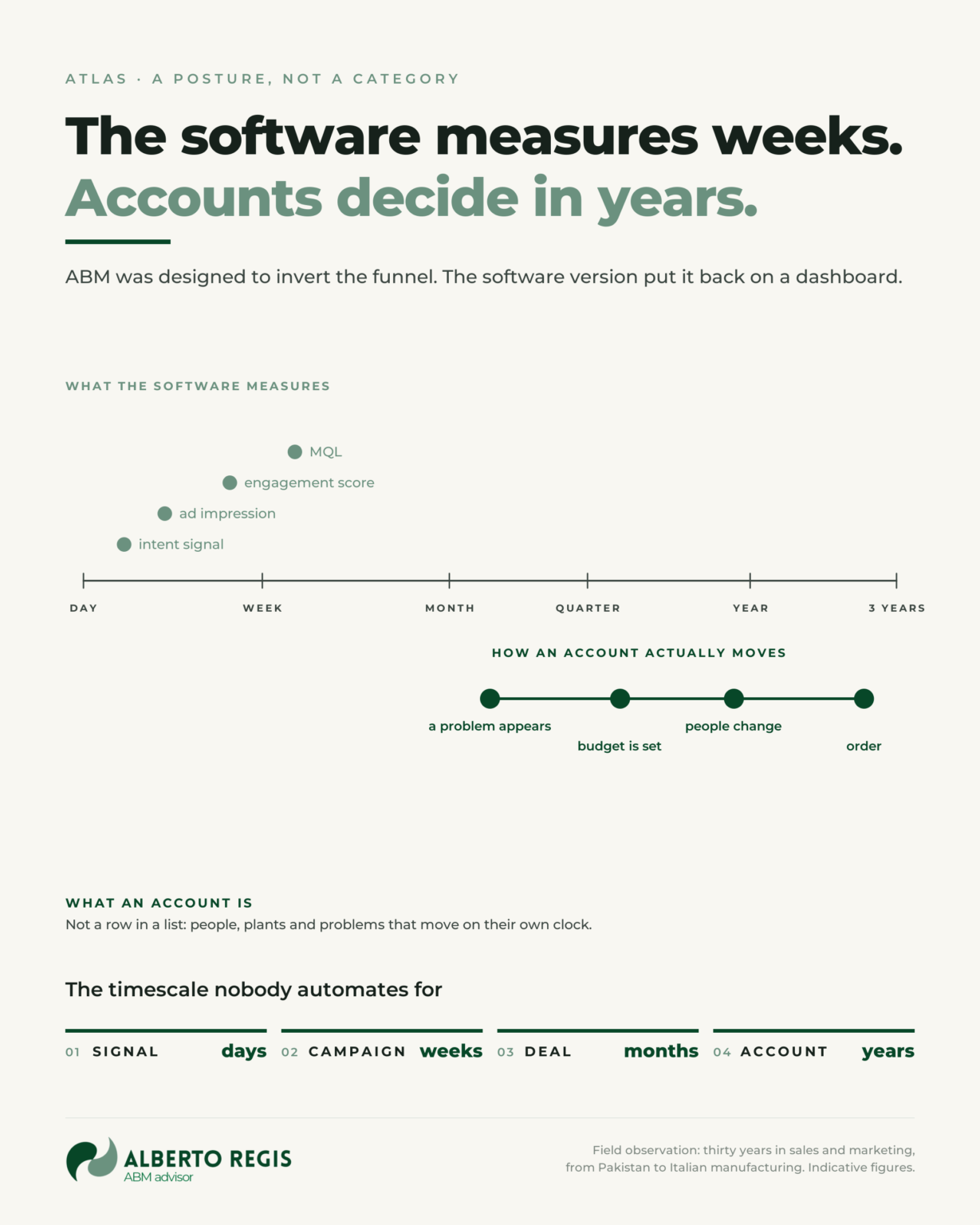
There is one more thing the industrialized version cannot accommodate, and it is the most important of all: time.
Complex industrial decisions do not happen at the speed of a campaign. They unfold over many months — the average B2B decision cycle now runs well beyond a year — and the outcome is very often settled before any formal process begins. By the time an RFQ is issued, the shortlist has usually already formed in the minds of the people who wrote it. The vendors on that list are the ones who were present, credible, and trusted during the long, quiet stretch before anyone was officially buying anything. Everyone else is competing for a slot that no longer exists.
This is the single most consequential fact in strategic B2B, and it is invisible to any system built around capturing demand once it appears. Demand capture arrives at the RFQ. ABM, properly understood, does its work in the year before the RFQ — earning the reputation and building the relationships that determine who gets shortlisted in the first place. That is not a slower version of the same game. It is a different game, played on different ground, for a prize that is decided before the game everyone else is playing has even started.
A posture, not a category
So the honest definition of account-based marketing looks nothing like the one the market has absorbed. It is not a technology you buy. It is not a list you upload. It is a strategic posture: the decision to treat a small number of specific accounts as markets worth understanding completely, and to invest human attention — not automated workflows — in the people who will decide, together and slowly, whether to let you in.
That definition scales badly. It resists dashboards. It cannot be run against five hundred companies by a platform and a single coordinator. Those are not its weaknesses. They are the reasons it works, because they are the reasons your competitors, armed with the same software and the same intent data, will not do it. The discipline was never supposed to be efficient. It was supposed to be decisive — on the accounts where winning actually matters and losing is expensive enough to justify the effort of being human about it.
Bev Burgess named a strategy in 2003. The software industry sold you a category. They are not the same thing, and the gap between them is where the accounts you most want to win are quietly being decided.