
Why Account-Based Marketing Runs on Small Data — and Why Big Data Answers the Wrong Question
The B2B industry sells data by the ton. Intent platforms, enrichment providers, predictive models, buying-signal engines — all of it promising the same thing: more data, better decisions, at scale. The implicit theory is that intelligence is a volume problem, and that whoever holds the largest dataset understands the market best.
For most of marketing, that theory is roughly right. For account-based marketing, it is not merely wrong. It is a category error. Because the kind of knowledge that wins a strategic account is not a larger quantity of the same thing the platforms sell. It is a different kind of thing entirely, and more of the first kind will never add up to it.
Two questions, not two dosages
Big data and small data are usually described as points on a single spectrum — one large, one small, otherwise the same. They are not. They answer two different questions, and the difference is the whole matter.
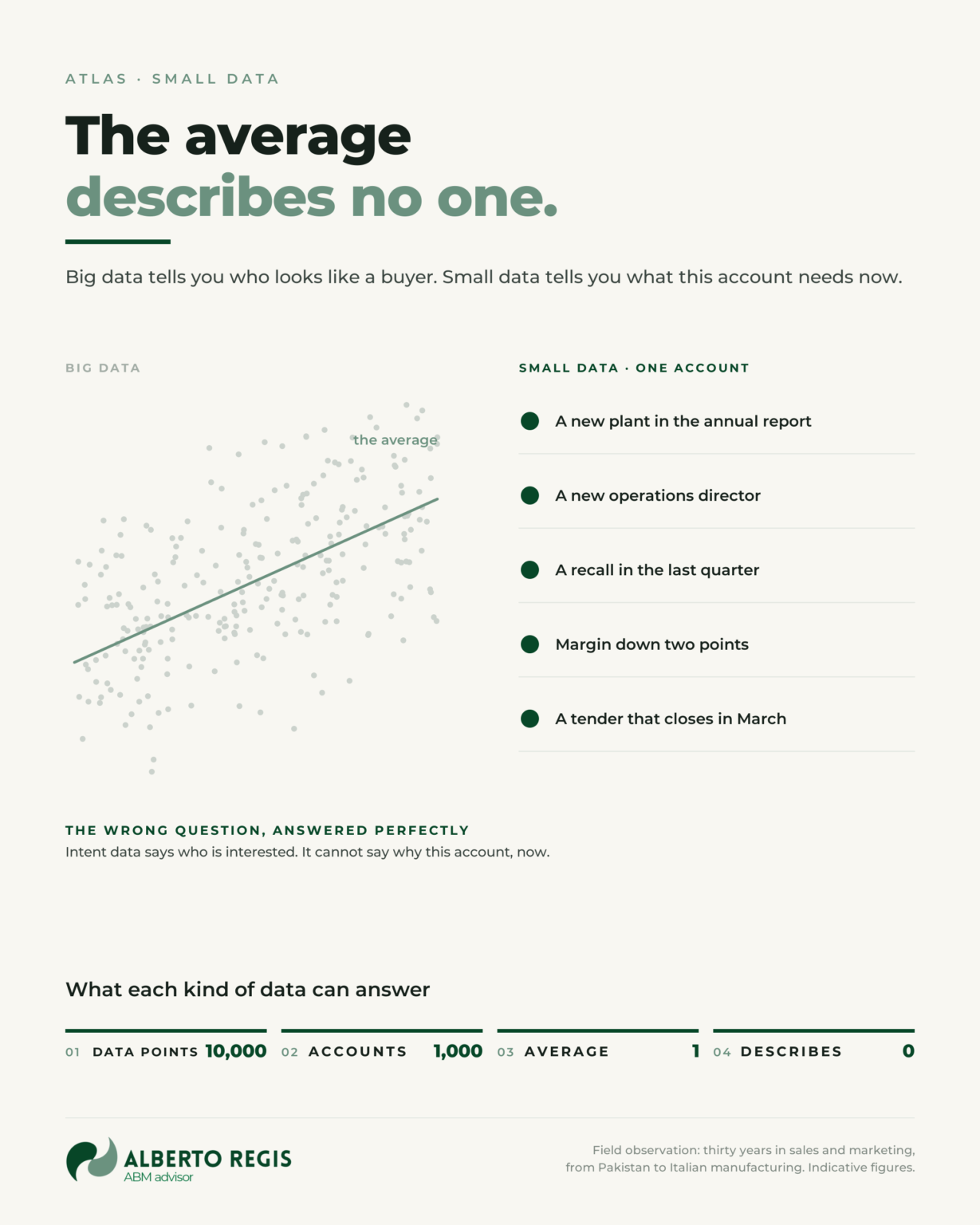
Big data answers the question what do many do? It finds patterns across populations, correlations across thousands of cases, probabilities that hold on average. Its power is statistical, and its output is always a statement about the aggregate: this segment tends to behave this way, that signal usually precedes that action. It is, by construction, a machine for describing the many. It can tell you what is probable. It can never tell you what is true of the one.
Small data answers a different question entirely: what is true of this? Not this segment, not this cohort, not companies like this one — this company, this account, this specific human system with its specific history and specific pressures. It is the close reading of a single case until that case gives up what makes it itself. Philosophers of science had names for these two ways of knowing a century ago: the nomothetic, which seeks general laws across many instances, and the idiographic, which seeks to understand the single instance in its particularity. Big data is nomothetic. Small data is idiographic. They are not more and less of one method. They are two methods, pointed at two different objects.
And account-based marketing is idiographic by definition. The founding idea of the discipline — treating an account as a market of one — is a commitment to the single case. A market of one has no population to average over. It has no cohort whose behavior predicts its own. It has only itself. Which means the nomothetic machine, however vast, is aimed at a target that does not exist in ABM. There is no “many” here to describe. There is only this account, and the question that matters is the one big data is structurally incapable of answering.
Why the average describes no one
Consider what happens when you apply population-scale data to a single account. You learn that manufacturing CFOs, in aggregate, worry about supply-chain resilience. You learn that companies of this size, on average, increase automation spend after a certain trigger. You learn that firms in this sector typically begin evaluating vendors at a certain point in their planning cycle.
Every one of these facts is true. Not one of them tells you what to do on Tuesday with the CFO of the specific company you are trying to win. The average CFO does not exist. The one you are pursuing has a name, a particular problem this quarter, a specific sentence he used in the last analyst call, a real reason the last project stalled. The aggregate has quietly erased all of it — because erasing the particular is precisely what averaging is for. Big data does not fail to see the individual account. It is designed not to. The specificity that the statistician treats as noise, to be smoothed away in pursuit of the pattern, is the exact thing that makes an account winnable.
This is the reversal at the center of the whole argument. In statistics, the outlier is a problem to be managed — the anomaly that distorts the model, the case you correct for. In ABM, the outlier is the account. What makes this company different from every other company like it is not noise contaminating the signal. It is the signal. It is the only signal that matters, because it is the only thing your competitors, working from the same population data, will not see. The moment you decide to win a specific account, you have decided to live inside the anomaly that big data was built to discard.
What small data actually looks like
Small data in ABM is not a smaller spreadsheet. It is a different kind of material, and most of it is not numeric at all.
It is the single financial statement of the target company, read not as a finance professional reads it but as someone looking for pressure — where the margins are thinning, which line item grew when the others did not, what the chairman’s letter emphasizes and what it conspicuously avoids. One annual report, read this way, is a map of an account’s strategic imperatives. It is small data in the strict sense: one document, one company. It is also denser with usable intelligence than any dataset of a thousand firms, because it is about the firm you are actually trying to win.
It is the review a departing engineer left on Glassdoor, which tells you what the account is really like to work inside. It is the phrase repeated three times in an earnings call, betraying the anxiety the leadership cannot stop circling. It is the union communication, the customer complaint, the offhand remark in an interview, the thing one person said in a meeting that reframed the entire account for you. None of this scales. None of it can be bought by the record. None of it aggregates into a model. And all of it, on a single account, is worth more than the entire intent-data subscription — because it is deep and narrow rather than wide and flat, and depth on the one account is the only thing the market of one rewards.
The term itself was popularized to describe consumer research — the small, telling clues in a single household that reveal what surveys miss. But in ABM it means something more demanding than clue-hunting. It means the disciplined reconstruction of one account’s reality from the few dense sources that actually carry it, until you understand that account well enough to say something no competitor working from population data could say.
The intelligence that cannot be bought
Here is why this matters commercially, and not just epistemologically. Small data cannot be purchased, and that is its entire value.
Anything you can buy, your competitor can buy too. The same intent platform, the same enrichment provider, the same predictive model — sold to everyone, producing the same population-level picture for everyone. Data you can acquire by transaction confers no advantage, because advantage is by definition what others do not have. The small data on a specific account is the opposite: it exists only for whoever did the work of finding it. It sits in a financial statement no one bothered to read commercially, in a sentence no one else noticed, in the gap between what the company says and what its numbers reveal. It is available to attention, not to spending. And attention does not scale, which is exactly why the account you win with it stays won.
This is also why real account intelligence resists the dashboard and refuses to run against five hundred targets at once. The work is irreducibly particular. You cannot understand a single human system you have not troubled to study, and you cannot study five hundred of them with the depth any one of them requires. The constraint is not a weakness of the method. It is the method. ABM is small-data work because winning a market of one is small-data work, and the companies that try to industrialize it back into a population problem are quietly conceding the only ground on which the account was ever winnable.
The wrong question, answered perfectly
The seduction of big data is that it answers its question so well. The models are genuinely good at telling you what is probable across the many. The mistake is bringing that answer to a problem that never asked the question.
Account-based marketing does not need more data. It needs the right data, and the right data is small: few sources, read deeply, about one specific account, in search of the particular truths that make it different and therefore winnable. Small data is not the consolation prize for organizations too poor or too unsophisticated to afford big data. It is the only kind of knowing that fits a market of one — and the accounts worth winning were always markets of one.
The industry will keep selling tonnage, because tonnage is what you can license. But the account you most want to win is not hidden somewhere in a larger dataset, waiting for a bigger model to surface it. It is sitting in plain sight, in a handful of documents and remarks that describe it exactly, and that no one competing for it has bothered to read closely. That is where the account is decided. Not in the size of the data, but in the smallness of the attention paid to the one thing that matters.