Monday, nine in the morning. The operations director of an account you care about is back at her desk after the event you hosted on Thursday. She has good memories: the dinner, the working session, two interesting people at her table.
At ten she has her weekly meeting with the CFO, procurement and IT. None of them were there. Between two agenda items she has three minutes to explain what she heard. That is where your idea takes root, or dies.
Yet most companies still judge their events by a single question: how many of the people we invited actually came? It is a fair question, but it looks at the room. The decision is made somewhere else.
This piece is about designing B2B events for the people who will not be there: what to do before, during and after, four measures that replace the attendance count, and four long-running events that have worked this way for decades.
A B2B event should be judged by how far the idea travels in the weeks that follow. That is why it has to be designed backwards, starting from the members of the buying group who will never sit in the room.
In short
- One person is in the room; thirteen make the decision. Forrester puts the typical B2B buying decision at 13 internal stakeholders and 9 external influencers.
- An event is the one place where two kinds of trust are built at once: trust in competence ("they know what they are talking about") and trust in care ("they have our interests at heart").
- Most events obsess over the day itself and leave the weeks before and after to chance. The method reverses the proportions.
- Before, you map the accounts and the people who will receive the message back at the office. During, you continue a conversation that has already started. After, every participant gets what they need to carry the idea into their buying group.
- AI never enters the moment trust is built, but it makes everything around that moment affordable at scale.
Why counting attendees is the wrong question
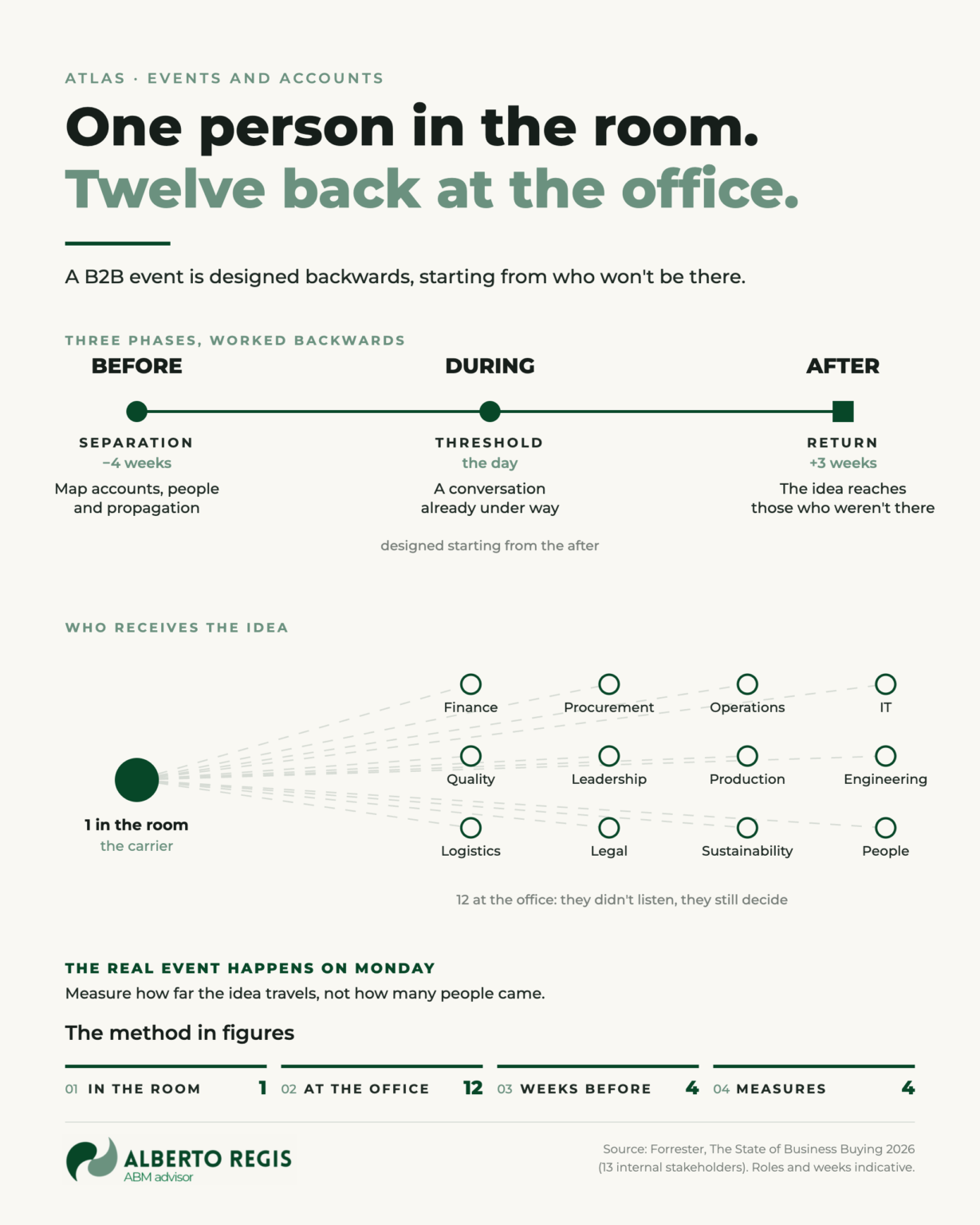
One in the room, thirteen around the table
In the traditional logic, an event succeeds when the room is full of the right people from the right companies, and the feedback form says they enjoyed it. In an account-based programme all of that still matters. It is only the starting point.
Forrester's State of Business Buying 2026 counts, on average, 13 internal stakeholders and 9 external influencers behind a B2B purchase. For larger or more complex purchases the numbers go up.
From each account, your event usually gets one of them. The other twelve did not listen, did not meet anyone, did not feel the atmosphere. Yet they are the people your idea will have to convince.
The real event happens on Monday
The participant goes back to work and becomes, willingly or not, the spokesperson for what she heard. If all you gave her was a pleasant memory, she will pass on a pleasant memory. That will not move a CFO.
Forrester adds a detail that matters: procurement now acts as a decision maker in 53% of buying cycles, and gets involved from the start. Procurement is almost never among the people who came to your event.
I have written about the doors a buying group opens and closes in The Secret Doors ABM Opens. The question here is narrower: what has to reach each of those people, through the one person who was in the room?
Why the event is still the strongest lever you have
Two kinds of trust, in the same moment
In B2B, trust is hard currency. It is no accident that "credit" comes from the Latin for "to believe". Venice has known this for centuries: merchants went to the Rialto to learn what was happening and, above all, whom to trust.
In 1995 Daniel McAllister studied 194 managers and professionals and showed that trust between people at work takes two distinct forms, with different origins.
- Cognition-based trust comes from competence and reliability: "they know their stuff". It is the territory of thought leadership.
- Affect-based trust comes from the relationship and mutual care: "they care about us". It starts with a personal invitation.
Good content builds the first. A relationship nurtured over time builds the second. There is only one place where both are built together, in front of the same person, at the same moment: the event.
The more abundant AI makes content, the more the room is worth
According to Forrester, almost every business buyer (94%) now uses AI during the buying process, and then checks what it says with people they trust: peers, experts, colleagues.
TrustRadius's 2026 B2B Buying Disconnect Report points the same way. 94% of buyers who use AI fact-check it, and the share who do so always or very often rose from 58% to 72% in a single year.
The more AI makes content and personalisation abundant, the scarcer and more valuable the room where people look each other in the eye. That is where buyers go to verify.
Separation, threshold, return: the event as a rite of passage
In 1909 the anthropologist Arnold van Gennep described rites of passage in three phases: separation from the old world, the threshold, and the return with a new role. Victor Turner picked up the scheme sixty years later.
A corporate event has the same structure. Today, though, it obsesses over the threshold (venue, agenda, hospitality) and leaves separation and return to chance.
The method is to turn the perspective around and work backwards: start from the weeks after the event and from the people who must receive the message, then work back to a month before.
Before the event: map who will receive the message back home
The imperatives of each account and each person
The work starts long before the invitations go out. For every account you want in the room, you reconstruct the company's imperatives and those of each member of the buying group, paying particular attention to the people you can and want to invite.
Annual reports, the participant's profile and the map of decision makers already tell you who will receive the message back home, and in which language. The CFO will want to hear about risk and return, operations about continuity, the CEO about growth.
It is the same translation work I describe in Your engineers explain the product beautifully: one idea, rewritten for each person who has to answer for it. The raw material is the small data of each account.
The propagation map
The second tool is less familiar. For each account you sketch how the message will travel after the event: from the participant to whom, with which argument, in which meeting.
On that map you find the nodes, the people who listen to the participant and are listened to in turn. That is where you put your effort, so the impact is as wide as possible.
The invitation as the first move in the conversation
With that knowledge, you write invitations and messages that involve people before they even walk in. A short interview, a question about their market, a request for a small contribution that will become part of the event.
Whoever receives an invitation like that understands at once that they are not one of three hundred names on a list.
During the event: continue a conversation that has already started
What people help build, they keep
If the work before the event was done well, the event is the continuation of a conversation, not its start. Its value grows when people take part in building it: with what they said in the interviews, with the contribution they sent, with a physical, hands-on experience.
In a 2025 programme for a large software group, we ran a LEGO® Serious Play® session with the invited decision makers. Each of them gave physical shape to the problem of their own function.
Michael Norton, Daniel Mochon and Dan Ariely called the underlying mechanism the IKEA effect: we value what we help build. With one precise condition, shown in their experiments: the effect disappears when the work is left unfinished.
That is why every participant, before leaving, completes the idea in their own words. That sentence is what they will repeat on Monday.
Seat the room from the map
Left to themselves, people mostly talk to the people they already know. Paul Ingram and Michael Morris of Columbia Business School measured it with electronic badges at an executive mixer.
Almost everyone said they had come to meet new people. They spent most of the evening with people they already knew.
So useful encounters are designed, not hoped for. Because you got to know the participants well in the weeks before, you can seat each of them next to the people with the closest needs and opportunities. Everyone's experience becomes richer.
After the event: the participant as carrier
The follow-up arrives before the energy fades
Whoever was in the room goes home as the carrier of a message they feel is their own, because they helped build it. The follow-up has to arrive within a few days, before the working week buries everything, and then continue over time.
A message that helps them take the idea inside, without going over their head
Each participant receives a personal message. Not a thank-you note with photos of the evening: material that helps them take the idea into their buying group, in the right words for each person.
The rule is never to go over their head. If you email their CFO directly the next day, you take away the role the event gave them. An example, written for this article:
Dear Ms Weber, thank you for Thursday. Your model raised the point nobody else put on the table: the line stoppage when a critical supplier changes. I attach a one-page summary in your own words, and two variants: one with the risk-and-return figures, in case it helps with your CFO, and one on qualification lead times for procurement. Use them only if they are useful. If you like, we could talk it through for twenty minutes next week.
The same message gives marketing and sales what they need to turn the relationship into an opportunity: they know what struck that person, whom she will take it to, and with which argument.
Four measures of how far the idea travelled
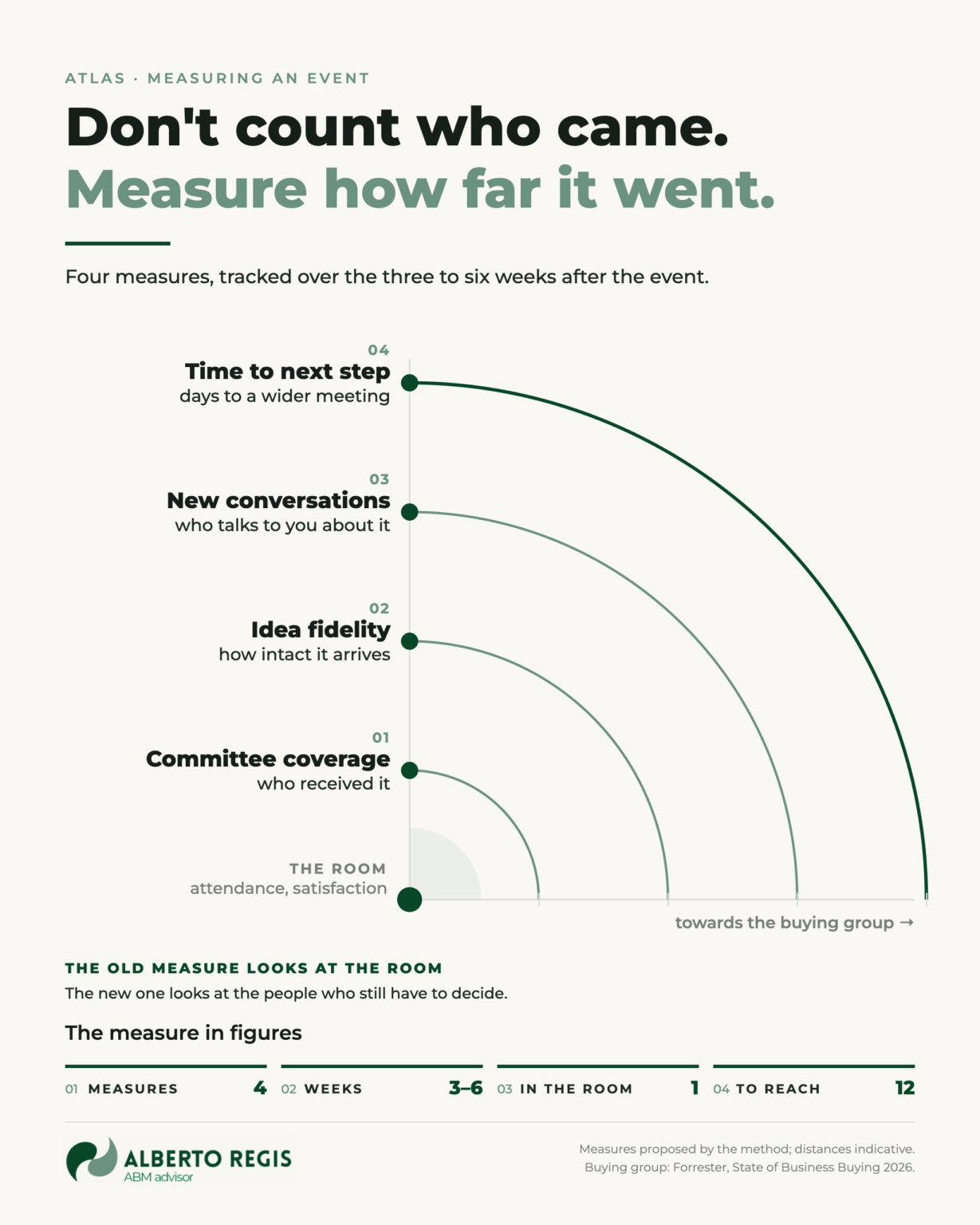
If the goal is for the idea to reach the people who were not there, the measures have to look there too. I propose four, to be tracked over the three to six weeks after the event.
| Measure | What it tells you | How to track it |
|---|---|---|
| Committee coverage | How many members of the mapped buying group received the message | Forwards, requests for material, new names getting in touch |
| Idea fidelity | How intact the idea arrives, in the participant's own words | What other decision makers repeat back when you meet them |
| New conversations | Meetings with people from the account who were not in the room | Sales and marketing calendars, account by account |
| Time to next step | Days between the event and the first meeting with several people from the account | Event date against the date of the first wider meeting |
None of the four asks how many people came. All of them ask how far the conversation went.
Four events, read with fresh eyes
Premio Campiello: culture as the umbrella
The Premio Campiello, one of Italy's leading literary prizes, was founded in 1962 by the industrialists of the Veneto region. Alongside literature, it built its reputation as a meeting place for entrepreneurs and business leaders.
People who have seen it from the inside describe guests seated "by chance" in the same boxes at the Teatro La Fenice, after their needs had been understood, and then followed up personally for weeks. Separation, threshold and return, decades before anyone called it ABM.
Sun Valley: the bank that convenes rather than sells
Every July the investment bank Allen & Company gathers the leaders of media and technology in Idaho. On stage it sells nothing. Yet deals that made history were born there.
In 2013 Donald Graham, who had asked Allen & Company to find a buyer for The Washington Post, met Jeff Bezos at the July conference.
By August the sale had been announced, as Graham himself recounted. Sun Valley was the threshold; the preparatory work had taken months.
Cernobbio: a consultancy's relationship programme
The forum at Villa d'Este on Lake Como has run since 1975 and is organised by a consulting firm, The European House – Ambrosetti. Fourteen people attended the first edition; today places are capped at around 250, according to the organisers.
Seen clearly, it is the relationship programme of the firm that runs it: the studies presented are its own, the people in the room are its relationships. And, as the Italian daily Il Post put it, the most important things happen during the breaks.
The World Manufacturing Forum: the report that stays
The World Manufacturing Forum has met since 2011, its first edition held in Cernobbio, and since 2018 each edition has come with a report. The World Manufacturing Report keeps circulating long after the room is empty.
It is the cleanest form of return: something the participant can take back to the company, which speaks to the people who were not there as well.
Where AI fits, and where it does not
AI never enters the moment trust is built. That moment stays between people, in a room. But AI makes everything around it sustainable, including work that until recently cost too much to do for every account.
- It reads accounts and buying groups: annual reports, news, profiles, signals of change.
- It helps compose the room, matching participants' needs and opportunities.
- It translates the idea for each role, starting from the participant's own words.
- It helps build propagation maps and find their nodes.
- It measures how far the message travelled in the following weeks.
This is work that used to be done for one account, perhaps three. Now it can be done for every guest, and that is what turns an event from a communication moment into an instrument of one-to-few ABM.
Frequently asked questions
How do you measure the success of a B2B event?
Not by attendance or satisfaction scores, which are still useful but only look at the room. By how many members of the buying group the idea reached, how many new conversations it opened, and how long it took to get to the next meeting with the account.
Is an event a tactic within ABM, or can it be ABM itself?
Designed in three phases, account by account, the event becomes the moment of maximum interaction in an ABM programme. Without the before and after, it remains a good communication moment that does not move decisions.
How early should the work start?
At least a month before the event, to map accounts, people and propagation and to write personal invitations. The follow-up starts in the days immediately after and continues for several weeks.
Does it need a large event?
No. The method works better with a few carefully chosen people, because each participant has to be understood in depth. The first Cernobbio forum had fourteen.
What if nobody from the account turns up?
The work done beforehand is not lost. The account map and the message translated for each role remain, and can be used for direct outreach to the buying group.
Before you invite an account to your next event, check whether an account-based approach fits your company at all. Four questions, a few minutes.
Is ABM right for your business? →And one question to ask before every invitation: who will not be there, and what needs to reach them? If you would like to talk it through, get in touch.
Sources
- Forrester, The State of Business Buying, 2026, and press release of 21 January 2026.
- TrustRadius (HG Insights), 2026 B2B Buying Disconnect Report.
- McAllister, D. J. (1995), Affect- and Cognition-Based Trust as Foundations for Interpersonal Cooperation in Organizations, Academy of Management Journal, 38(1).
- Norton, M. I., Mochon, D., Ariely, D. (2012), The IKEA effect: When labor leads to love, Journal of Consumer Psychology, 22(3).
- Ingram, P., Morris, M. W. (2007), Do People Mix at Mixers?, Administrative Science Quarterly, 52(4); summary by Columbia Business School.
- van Gennep, A. (1909), Les rites de passage; Turner, V. (1969), The Ritual Process.
- Fondazione Il Campiello, history of the Prize.
- Nieman Lab, interview with Donald Graham, 6 August 2013.
- The European House – Ambrosetti, 50 years of the Cernobbio Forum; Il Post, 7 September 2025.
- World Manufacturing Foundation, The 2026 World Manufacturing Report.