
The Secret Doors ABM Opens, and Why They Only Open From the Inside
Every salesperson, at some point, fantasizes about a master key. A tool, a list, a signal, a piece of data that would open any door in any account, on demand. The entire intent-data industry is built on that fantasy. Buy the platform, watch the accounts light up, walk through the doors that light points to. It sells because it flatters a wish everyone in B2B secretly holds: that access could be a purchase rather than a relationship.
The doors that decide strategic accounts do not work that way. They have no external lock. There is nothing to pick, nothing to force, no signal that swings them open. They open from the inside, and only when someone standing on the other side decides to open them for you. Understanding why that is true, and what it takes to be the person that happens for, is the actual reason account-based marketing exists.
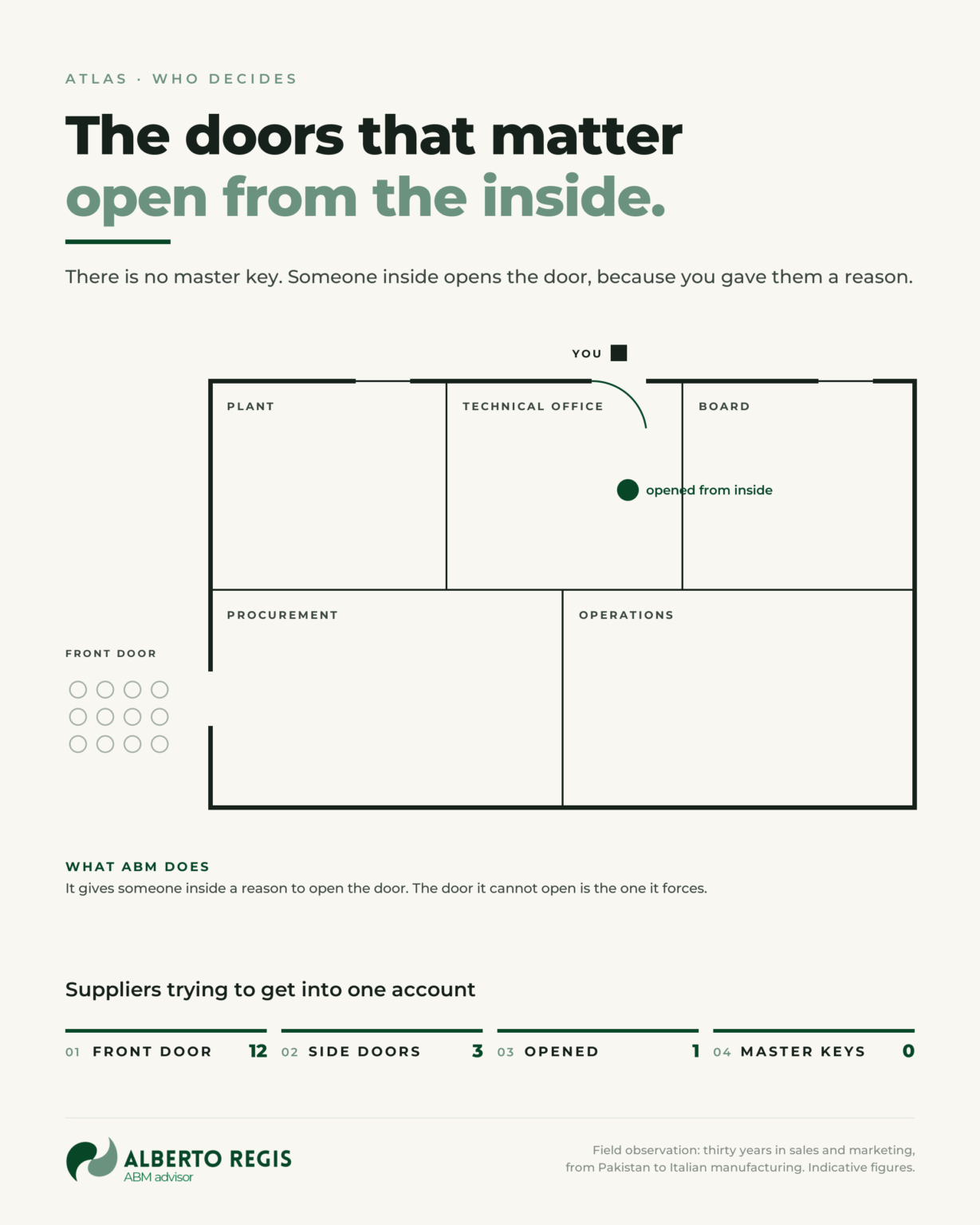
Two kinds of door
Every large account has a front door, and everyone knows where it is. It is the CEO’s inbox, the procurement portal, the “contact us” form, the CFO’s LinkedIn. These doors are guarded precisely because they are obvious. A gatekeeper sits at each one whose entire job is to keep people like you out, because a hundred people like you knock every week. The front door is not a way in. It is a filter, built to convert the effort of knocking into the reassurance of a “no.”
Then there are the other doors. The operations director whose quiet frustration is the real reason a project has stalled. The technical lead the CFO actually trusts on anything involving risk. The former colleague, now three floors up, whose word carries more weight in a room than the org chart would ever suggest. The external advisor the founder calls before making any large decision — someone who is not an employee, not in the CRM, not in any database you can buy, and yet is present in every consequential conversation.
These are the secret doors. They are secret not because anyone is hiding them, but because they are invisible to the instruments most companies use to find their way in. They do not appear in firmographic data. They do not fire intent signals. They are not job titles you can filter for. They are relationships and dependencies inside a specific human system, and the only way to see them is to understand the account well enough that the map draws itself.
Why the secret doors are the ones that matter
Here is the part that makes this more than a metaphor. The decision you are trying to influence is not made at the front door. It is made behind the secret ones.
A complex B2B purchase is not decided by a single buyer. It is settled by a group — commonly six to ten people, by Gartner’s count — who arrive with different information, incompatible priorities, and their own private reasons to say no. The decision is the outcome of the friction between them. And most of that friction is resolved in conversations you will never attend: a hallway remark, a forwarded message, a “what do you actually think of these people” asked quietly of the one colleague whose judgment everyone trusts.
Whoever holds influence in those unseen conversations holds the account. If that person has never heard of you, or worse, has heard of you only as another vendor who came through the front door with a pitch, the decision is being shaped against you in rooms you cannot enter. You can run a flawless campaign at the front door and lose the account entirely to a dynamic playing out behind a door you did not even know existed.
This is what systems thinking makes unavoidable once you take it seriously. An account is not a company with a decision-maker at the top. It is an ecosystem of interdependent people, and influence flows through the connections between them, not down the boxes of the hierarchy. The secret doors are simply the places where that influence actually concentrates — which is almost never where the org chart says it should.
Why they open from the inside
Now the harder truth. Even once you can see these doors, you cannot open them. That is not a limitation of your tools. It is the nature of the door.
A person opens an internal door for you — makes an introduction, vouches for you in a meeting, tells you what is really going on — for one reason, and it is not because you asked well. It is because opening it costs them nothing and might even help them. They open it when being associated with you makes them look good rather than foolish, when what you bring makes their own position stronger, when trusting you is the safe choice rather than the risky one. In other words, they open the door when you have already made yourself useful to them, before you needed anything in return.
This is the mechanism the platform fantasy cannot touch, because it runs on human reciprocity, and reciprocity has a fixed direction. Value first, access second. Never the reverse. The neuroscience of trust describes it cleanly enough — the sense of safety that lets one person extend themselves for another is a physiological state, built through repeated, low-threat, genuinely helpful contact, not manufactured by a well-timed sequence. You cannot automate your way into it, and you certainly cannot buy it. You can only earn it, slowly, by being the rare outsider who showed up with something worth having and asked for nothing yet.
That is why the doors open from the inside. The lock is trust, and trust is held by the person on the other side. Your job is not to force it. Your job is to become someone they want to open it for.
What ABM actually does
Set against this, the promise of account-based marketing looks very different from the one the software category advertises. ABM does not hand you a master key. It gives you two things the fantasy never can.
The first is the map. Real account intelligence is the discipline of seeing the secret doors — of understanding a specific organization so thoroughly that its real influence structure becomes visible: who depends on whom, who trusts whom, where the frustrations sit, which relationships carry weight the titles do not. This is patient, human, un-scalable work, and it is the reason ABM cannot be run against five hundred accounts by a platform. You cannot map a human system you have not bothered to understand.
The second is the posture. Once you can see the doors, ABM is the discipline of earning the right to have them opened — showing up before there is anything to sell, bringing something genuinely useful to the specific people who matter, and being willing to do it for as long as it takes without demanding entry in return. It is reciprocity practiced at strategic scale, on purpose, toward the accounts worth the patience.
Neither of these is a technology. Both are refusals of the shortcut. And that is exactly why they work, because your competitors, holding the same data and the same tools, will keep knocking at the front door, mistaking the sound of their own persistence for progress.
The door that closes
There is a clock on all of this, and it is the reason patience is a strategy rather than an excuse.
Strategic decisions form slowly — the average industrial buying cycle now runs well over a year — and the outcome is usually settled before any formal process opens. By the time an RFQ appears, the shortlist has already taken shape in the minds of the people who wrote it, and those minds were made up in the long, quiet stretch beforehand, through exactly the internal conversations you were either part of or absent from. The RFQ does not open the door. It confirms which doors already opened, for whom, months ago.
This is the quiet cost of the front-door approach, and it is invisible until it is too late. Companies that wait for demand to declare itself arrive at the RFQ to find every secret door already opened for someone else — someone who was present, trusted, and useful while they were still optimizing their reply rate. The account was never lost at the RFQ. It was lost in the year before it, in rooms they never entered, through doors they never saw.
Being let in
So the honest version of “ABM opens secret doors” is not a story about access as conquest. It is a story about access as something granted. The doors that decide strategic accounts open from the inside, for the outsiders who made themselves worth opening them for, long before there was a deal on the table.
Account-based marketing is the deliberate practice of becoming that outsider: seeing the doors no data can show you, and earning your way to the other side of them one relationship at a time. It gives you no key, because there is no key. What it gives you is far rarer and far harder to copy — the intelligence to know where the real doors are, and the patience to be the person they finally get opened for.
The fantasy of the master key will always sell better. It asks nothing of you but a purchase. But the accounts worth winning were never behind a locked door waiting to be forced. They were behind a trusted one, waiting to be opened — and it opens for whoever earned it.