
Marketing Lento: The Art of Winning Only When It Matters
Marketing Lento starts from a contradiction. B2B selling has never moved faster, and B2B buying has never moved slower. Sequences, intent data and AI outreach have made the seller louder, while the buyer has gone quiet: longer cycles, bigger buying groups, most of the decision made before anyone calls a vendor.
The usual response is to accelerate again. This paper argues for the opposite: a deliberate slowing down. Not passivity, but precision. Being present in the right place, for the right person, in the months before any opportunity exists, so that when the account moves, your name is already in the room.
The Italian name is kept on purpose. This is not a change of pace. It is a different idea of how trust is earned, and of when commercial advantage is actually built.
The evidence in five numbers
- ~70% of the buying journey is done before buyers engage a vendor (6sense, 2024).
- 81% of buyers already have a preferred vendor at first contact (same study).
- ~90% buy from the list of vendors they had in mind on day one (Bain & Company).
- 379 days is the average B2B decision time (dentsu, 2024).
- 17% of that time is spent with all suppliers together; about 5–6% with each one when three compete (Gartner).
1. The paradox of acceleration
There is a contradiction at the centre of modern B2B marketing that few people discuss honestly. Admitting it would mean questioning the tools, dashboards and quarterly rituals we have spent a decade building and defending.
The contradiction is simple. Marketing has accelerated. Buying has slowed down. And it has not only slowed. It has spread across more people and moved underground, into channels no automation platform tracks.
On the selling side, everything is faster. Sequences run at industrial scale. Content is produced in volume. Intent signals are monitored in real time, and prospecting tools promise to find buyers who are "in market".
On the other side, companies take longer to decide, involve more people and do more of the work alone, before any vendor is invited in.
The window keeps shrinking
In 2012, CEB and Google measured that buyers were 57% through the purchase decision before contacting a supplier. In 2024, 6sense surveyed 2,509 buyers across three continents and found them nearly 70% through their process before engaging sellers.
The same study adds the detail that matters most: 81% already had a preferred vendor at first contact, 85% had set their requirements, and in more than 80% of cases it was the buyer, not the seller, who made the first move.
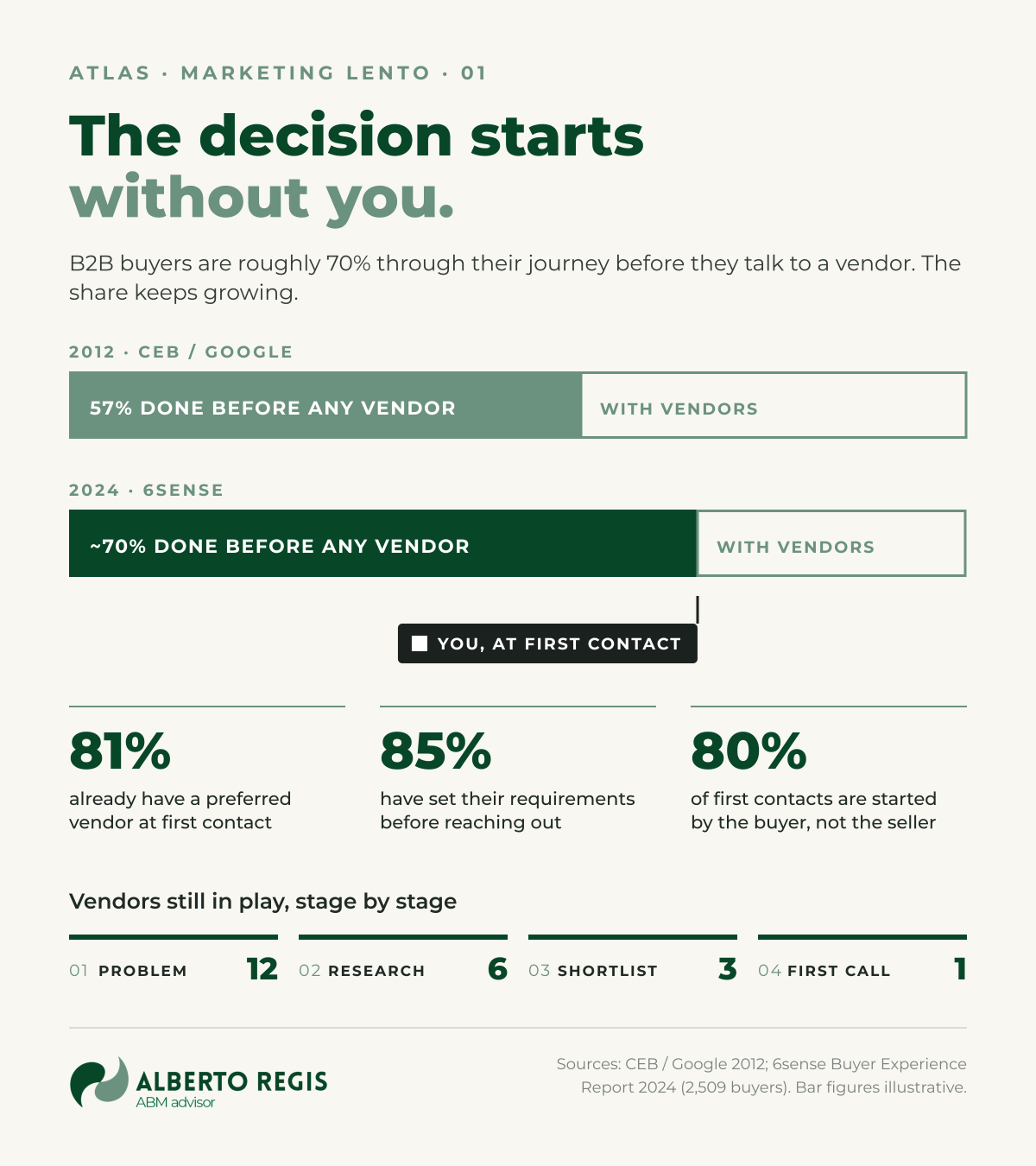
Everything else happens elsewhere: research done alone, conversations between colleagues, trade magazines read before the working day, names heard at an industry dinner. Slowly, that becomes the mental shortlist that decides who will be invited to compete.
379 days, and you get six percent
The buying group keeps growing. Forrester counts on average thirteen people inside the company involved in a purchase. Its 2026 edition adds nine external voices: advisors, partners, analysts, peers.
The cycle is long. dentsu's Superpowers Index puts the average B2B decision at 379 days, 54 days longer than in 2021. And Gartner's research shows how little of that time belongs to vendors: 17% spent with all suppliers together, around 5–6% each when three are in the race.
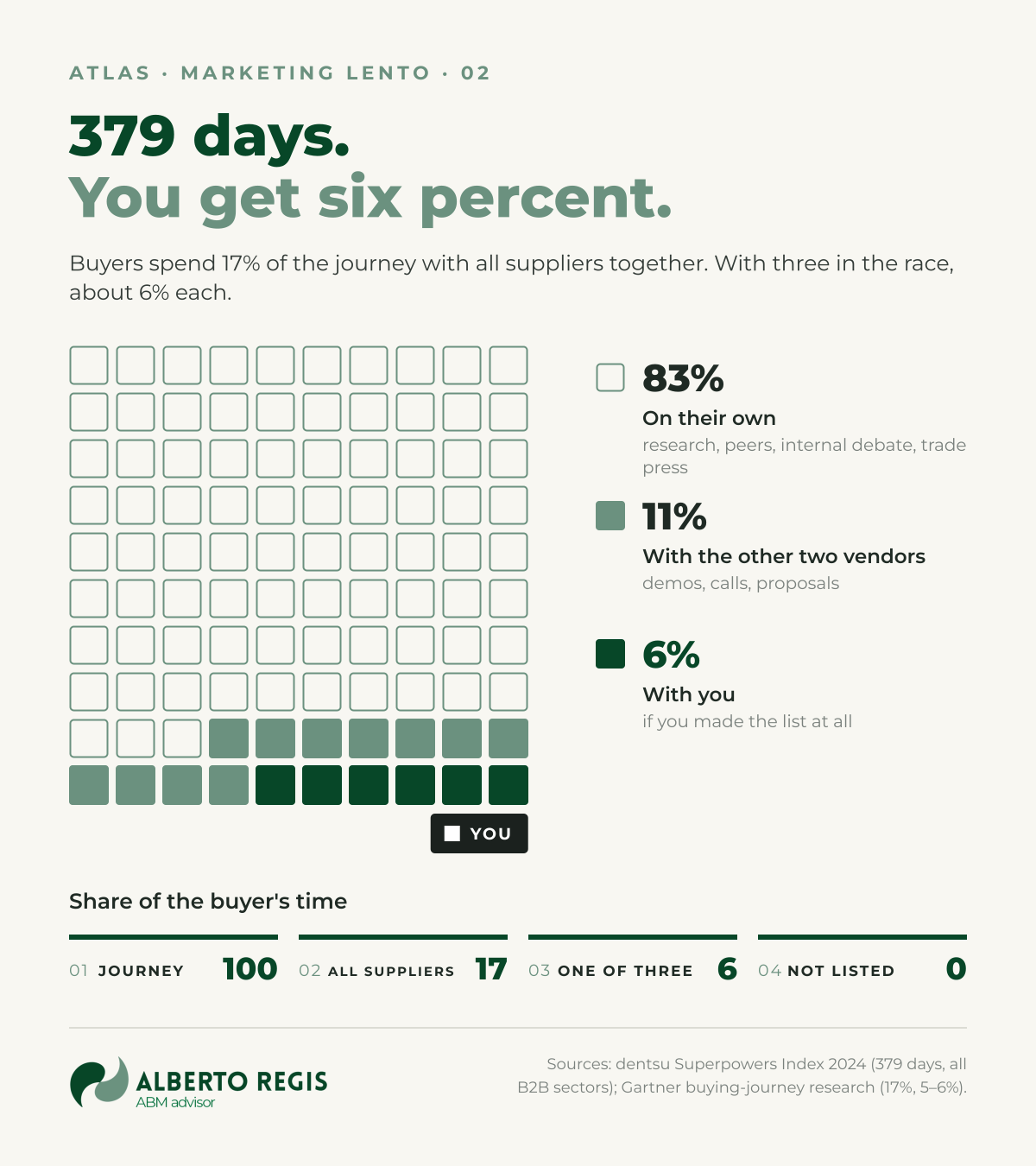
The dominant response has been to push harder. More sequences, more signals, more touchpoints. As if the answer to being excluded from 94% of the journey were to saturate the remaining 6%.
The answer is the opposite. Not acceleration, but a strategic slowing down: presence in the right place, for the right person, built patiently in the months before any opportunity exists.
That is what we call Marketing Lento. Not a preference for slower tactics, but a different idea of the commercial function: its purpose, its method, its time horizon and the kind of professional it needs.
2. An account is a living system
To be more than a tactic, Marketing Lento needs a theory that explains why linear sales models fail so predictably in complex sales, and why more technology will not fix them. The most useful one I know comes from the physicist Fritjof Capra.
Across four decades, from The Turning Point to The Systems View of Life, Capra argues that the properties of living systems sit not in their parts but in the relationships between them. You cannot understand a cell from its molecules, or an ecosystem from a list of species.
The commercial consequence is radical. A target account is not a company. It is not a list of contacts. It is a network of relationships, pressures, ambitions and fears that produces decisions no single person controls.
The decision does not come from the procurement director, nor from the CEO. It comes from the system: from a trusted colleague's recommendation that outweighs a better proposal, from names that kept appearing in the right places over the last twelve months.
Structure and organization
Capra makes a distinction that every ABM practitioner should carry in their pocket. The structure of a system is its physical parts: people, roles, departments, the org chart. Its organization is the pattern of relationships between them: who listens to whom, who is trusted, which outside voices matter.
Structure can change while organization stays. A company can redraw its chart and rotate its managers, and the informal network of trust remains largely the same. It is the organization, not the chart, that decides how the system behaves.
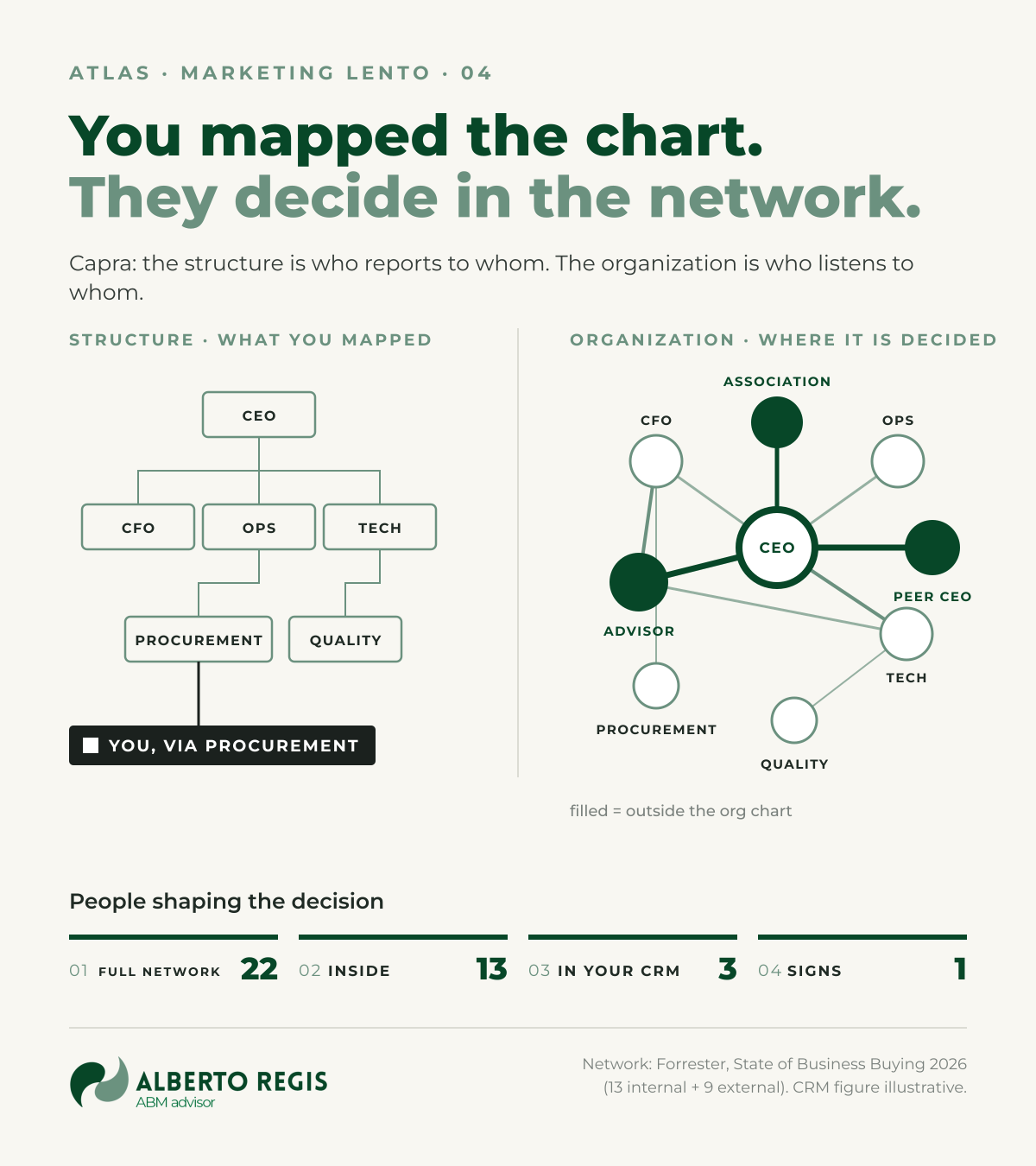
The vendor who maps the org chart has found the structure. The vendor who takes the time to understand who influences whom has started to understand the organization. I have written about the doors this second map opens: they are rarely the ones on the chart.
Systemic time and wu wei
Capra also offers a useful idea of time. Living systems have their own rhythms of growth, consolidation and renewal, set by their internal dynamics, not by external deadlines. What thrives inside them learns to recognize those rhythms.
In company terms: an organization that does not yet feel its problem as an imperative will not move, however good your solution is and however efficient your outreach. No acceleration on your side changes the timing of their maturation.
What you can change is where you are when it happens. That is where the Taoist idea of wu wei, action that does not force, becomes an operating principle rather than an ornament.
Wu wei is not withdrawal. It is the discipline of not pushing when the system is not ready, and of investing in preparation and presence so that when the budget opens and the committee forms, you are already inside the network.
The art of winning only when it matters is not opportunism. It is the long intelligence of someone who studied the system well enough to know when it is ready, and stayed close enough to be there when it moves.
3. Why the decision is made before the meeting
There is a scene I have seen many times in Italian manufacturing companies. A procurement director, a laptop, a spreadsheet. Price, reliability, delivery times, service, references. Weighted criteria and scores for each vendor. A model of rigor.
And it is rigorous, in its final form. What the spreadsheet cannot show is everything that happened in that person's head in the months before: an article read at seven in the morning, a conversation at a trade fair, a name mentioned by a colleague he trusts.
None of this has a column. But it has already shaped which numbers will feel convincing. Neuroscience suggests this is not a flaw in the process. It is how the brain makes high-stakes decisions.
Somatic markers: emotion as a prerequisite
In Descartes' Error (1994), the neurologist Antonio Damasio described patients with damage to the ventromedial prefrontal cortex. Memory, language and logic were intact. Yet they could no longer decide: choosing where to have lunch became an endless analysis.
His conclusion, the somatic marker hypothesis, is that emotion is not an interference in rational choice. It is a condition of it. Experience attaches an emotional tag to situations, and those tags narrow the options so that analysis can reach an end.
For anyone selling to manufacturers, the implication is direct. The vendor whose name carries a positive marker enters the spreadsheet with an advantage the analysis will tend to confirm rather than create. The vendor arriving cold has to persuade a brain with no reason to trust them.
Oxytocin and the cost of feeling sold to
The economist Paul Zak and colleagues studied the role of oxytocin in trust. In the best-known experiment (Kosfeld et al., Nature, 2005), 45% of participants given oxytocin entrusted the maximum amount to a stranger, against 21% in the placebo group.
A note of honesty belongs here. Later reviews have found these effects harder to replicate than first thought. I use the research as a mechanism that fits experience, not as a lever to pull.
The useful idea survives: trust grows when a counterpart seems credible and oriented to our interest, and it collapses under stress and the feeling of being manipulated. Useful content with no commercial ask attached lowers the defenses. A pushy sequence raises them.
Mirror neurons and the experience of being understood
The third mechanism comes from Parma, where Giacomo Rizzolatti and his team described mirror neurons in the 1990s: cells that fire both when we act and when we watch someone else act. Their role in human empathy is still debated, but the intuition is powerful.
Content that describes a buyer's reality in their own words, that names the pressure they live with and the question they have not yet formulated, produces recognition. Not "this is accurate", but "this person knows what it is like to be in my position".
Shamay-Tsoory's work separates cognitive empathy, the deliberate effort to understand another person's situation, from emotional empathy. The first can be trained and applied to commercial communication. Practised with precision, it produces the second in the reader.
Every touchpoint built in the months before an evaluation is building, below awareness, the trust that decides which vendor feels familiar and safe. The spreadsheet that follows confirms that architecture. It does not create it.
4. The broken funnel and the dark funnel
The most important critique of the dominant model is not philosophical but architectural. The funnel, the linear path from awareness to decision around which most B2B marketing is staffed and measured, describes a reality that does not exist in complex sales.
Jon Miller, who founded Marketo and then Engagio, has argued this with unusual credibility, since he built tools at both ends of the spectrum. The funnel rests on three assumptions, each questionable on its own and fatal together. I have written more on what the software industry sold us as ABM.
| Funnel assumption | What actually happens in complex B2B |
|---|---|
| Linearity | Decisions loop, stall for months, restart with new people and a new framing. No CRM captures it. |
| One buyer | Thirteen people inside the company, plus external voices, each with their own research and the power to block. |
| Vendor timing | The process starts when the buyer's problem reaches internal acknowledgment, often many months before any vendor is called. |
Organizing marketing around these assumptions concentrates investment at the bottom of the funnel, exactly when preferences are most formed and least open to change. Lead generation and conversion work are useful. None of them reaches the moment where the decision is shaped.
The dark funnel
The dark funnel, a term popularized by 6sense, names everything that happens before any trackable signal: peer conversations, advice from people the buyer trusts, articles in trade press, names heard in the corridors of a fair.
None of this fills a form or shows up in an intent dashboard. Yet this is where the list is built. Bain's research is clear: 80–90% of buyers start with vendors already in mind, and around 90% buy from that day-one list. Bain and LinkedIn add that "hidden buyers" carry half of the influence over it.
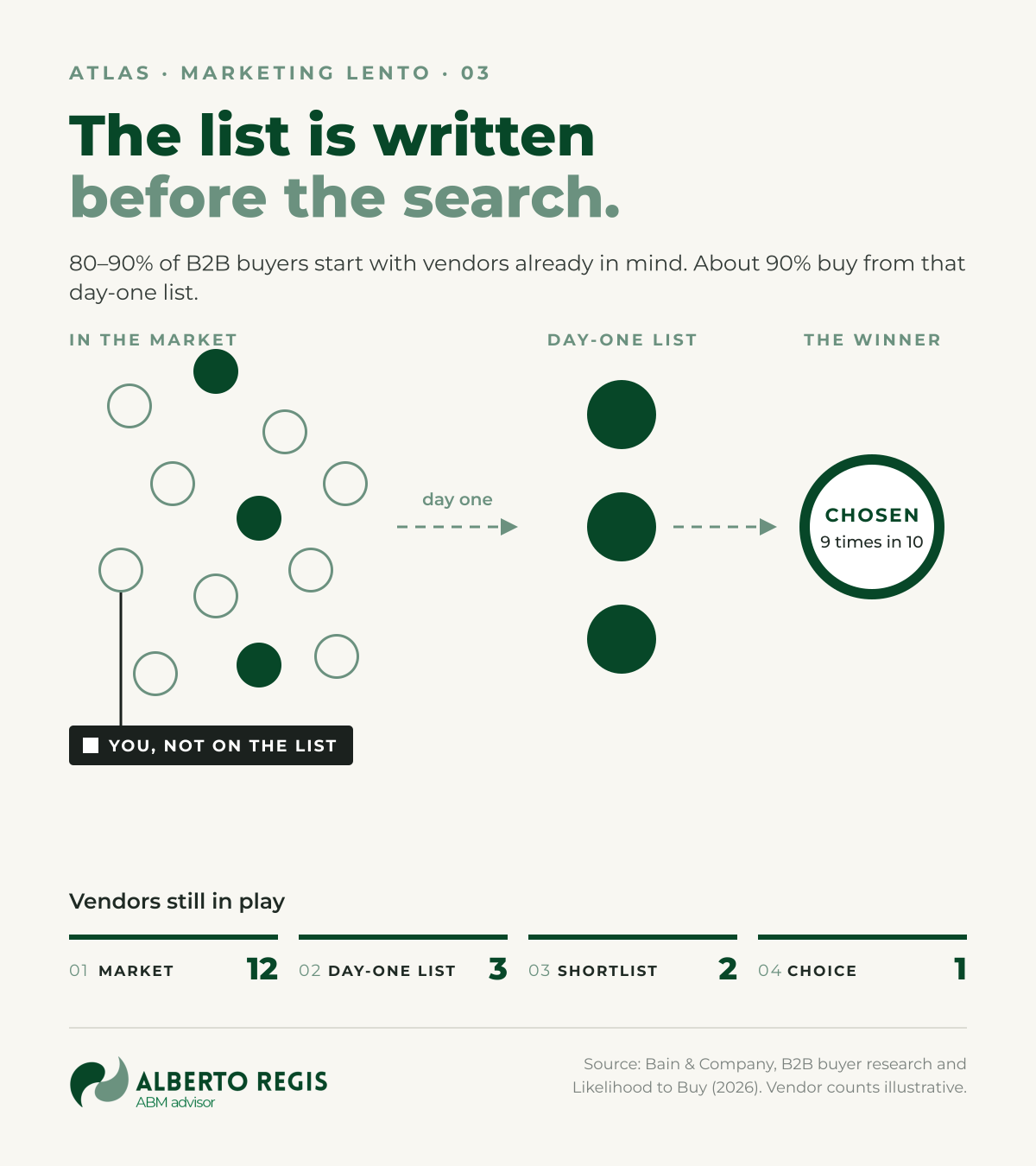
The most influential people in a complex decision, outside advisors, peer recommenders, the operators the CEO trusts, are invisible to tracking tools. Not because they hide, but because they work through channels older than digital marketing: personal trust and reputation built over years.
Quality cuts both ways
Edelman and LinkedIn have measured this for years. In their first study, 45% of decision-makers and 48% of C-level executives said a company's thought leadership directly led them to award it business.
The same research shows the other side: poor thought leadership can take a vendor out of consideration altogether. In the 2024 edition, only 13% rated the quality of what they read as very good or excellent.
Fast marketing does not achieve neutral indifference. At scale and without context, it scores negatively: it tells the buyer, before any argument, that this vendor does not understand their world. In a decision made 70% before the first conversation, a bad first impression is not a missed chance. It is a handicap.
Marketing Lento begins in the dark funnel, because that is where the competition takes place.
5. Marketing Lento, defined
Marketing Lento is not a methodology in the usual sense, a sequence of steps for the quarter measured on a predefined dashboard. It is an orientation that produces methodological consequences: where to spend time, which accounts deserve full depth, how and when to engage, and, with equal weight, when not to.
It draws on a specific tradition (Capra's systems thinking, the neuroscience of decision, the structural critique of the funnel) and applies it to one reality: the complex B2B sale, where the outcome depends less on the best pitch than on the deepest understanding built over the longest time.
Three distinctions turn it into practice.
Pains versus imperatives
Pains are the chronic problems every company in a sector shares: lower costs, more efficiency, better quality, faster time to market. Every brochure lists them. The buyer's brain has learned to filter them out before reading.
Imperatives are different in kind. An imperative is an urgent priority that a specific person, in a specific company, at a specific moment, cannot avoid, with consequences that are personal as well as organizational.
It is the production director who promised the board that downtime would stay under 3% this year. It is running at 7.4%, and the quarterly review is in six weeks. That is what keeps her awake, not "efficiency".
| Pain | Imperative | |
|---|---|---|
| Who has it | The whole sector | One person, in one company, now |
| Example | "We need more efficiency" | "Downtime at 7.4%, review in six weeks" |
| What it earns you | Polite attention | A forward to a colleague |
| How you find it | Market reports | Interviews, signals, small data |
The gap between pain and imperative is the gap between being relevant and being indispensable. Reaching it takes research before any message: interviews with comparable decision-makers, close reading of the account's signals. It is also the investment most often sacrificed to the pressure for reach.
It is why engineers who explain the product beautifully often lose the room: nobody in it is buying a product. Each person is solving their own imperative.
Messages versus signals
Fast marketing is built on messages: value propositions and calls to action, sent to as many people as possible. Marketing Lento is built on signals: small, precise, generous communications meant to reach one specific person and be useful to them.
A signal is an observation about the account's moment, or a technical problem no one in the market describes well, delivered through the right channel when it matters. Crucially, it does not present itself as a sales communication. It presents itself as something useful.
The courage not to scale
The third distinction is the least comfortable for teams measured on reach. Marketing Lento works, by design, on few accounts. At the one-to-one level, the Personafication System runs on three to ten accounts at a time, not thousands as in one-to-many programs.
Three to ten, because each account needs real work, and real work does not scale beyond a threshold without turning into the appearance of depth. I describe what this means in practice in The Market of One, and where one-to-few fits in The bet inside 1-few ABM.
The courage not to scale is not a resource constraint. In a market where every vendor chose volume, it is the strongest differentiator left.
6. Thought leadership as pre-commercial trust
The most undervalued asset a B2B vendor has is a piece of content that teaches a buyer something useful about their own situation, without asking for anything in return. A framework they did not have. A clearer view of their own problem.
Not a white paper that is really a brochure. Not a case study built to show off capabilities. Not a blog post that borrows the language of expertise to deliver a pitch. A real contribution: hard to produce, impossible to fake.
Source: Edelman–LinkedIn B2B Thought Leadership Impact Report 2024, about 3,500 decision-makers.
The premium matters. It is not paid because the vendor claimed the solution was worth it. It is paid because the quality of their thinking showed they understood the problem at the depth the price implies.
Good thought leadership works through all three mechanisms described above. It builds positive markers by repeated useful exposure. It lowers defenses through generosity. And it produces recognition when it describes the buyer's reality accurately. I have argued elsewhere that thought leadership is a matter of essence, not of format.
Where useful content comes from
What separates content that builds trust from content that erodes it is not production quality. It is origin. Useful thought leadership comes from real understanding of the buyer's operations, gathered through the account research Marketing Lento puts at its centre.
It knows what the production director of a mid-size automation company is dealing with right now: how Transizione 5.0 meets a forty-year-old shop floor, which questions she asks her team that the team cannot fully answer. And it speaks to that, in her language.
Two uncomfortable disciplines
- Patience. Investing in communication that produces no pipeline this quarter and no attributable lead, but builds the shortlist position that decides who is invited in twelve or eighteen months.
- Precision. Refusing to publish anything a buyer would not read for its own sake. Below that threshold, content is worse than silence. Silence is neutral. Poor thought leadership is a negative marker at scale.
Self-determination theory (Ryan and Deci, 2000) names three basic needs: autonomy, relatedness and competence. Good thought leadership serves all three. It informs instead of pushing, it shows the reader they are understood, and it makes them better at their job.
7. Why Italian manufacturing is its natural home
The argument applies wherever relationships, long cycles and distributed decisions define the market. But it finds its most natural home in Italian manufacturing, where the volume model is not just inefficient but incompatible with how business is done.
Companies inside this world often describe its features as constraints. For a vendor with patience, they are advantages.
Four features of the Italian industrial market
- Dense, durable networks. An industrial district is an ecosystem of relationships built over decades, sometimes generations. The CEO of an automation company in Reggio Emilia is very likely three handshakes away from a mechanical engineering owner in Vicenza. That network carries "I would vouch for these people".
- The weight of associations. Confindustria, Federmeccanica, UCIMU, SIRI, ANIE and dozens of territorial bodies are where decision-makers meet, compare notes and form opinions about suppliers. Being known there as a practitioner, not a salesperson, is access to the dark funnel.
- Resistance to cold approaches. An entrepreneur in the North-East who receives an unsolicited LinkedIn message from a stranger reads it through a cultural filter that expects context and introduction. The cold message creates a negative marker before its content is read.
- Very long cycles. In capital-intensive sectors (machinery, large automation systems, custom engineering) cycles run two or three years. A vendor who starts building presence when the tender opens is not months late. It is years late.
A case: two years of outreach, four months of silence
A PLM software company had spent two years trying to reach the C-level of a listed manufacturing group. Sequences unanswered, calls unreturned, messages absorbed by organizational silence. Every contact they had was operational: technical procurement, engineering, administration.
The people who controlled the decision, including the decision to give a new vendor even half an hour, were out of reach through the usual channels.
The intervention followed Marketing Lento for six months. Research into the account mapped the people around the decision: external advisors, peer industrialists, association figures, technical consultants the CEO consulted before any commitment.
Specific content, built on the account's imperatives, was distributed where those people actually read and met: trade press, sector events, professional networks. For the first four months, no outreach was sent to the account. All the investment went into presence and credibility.
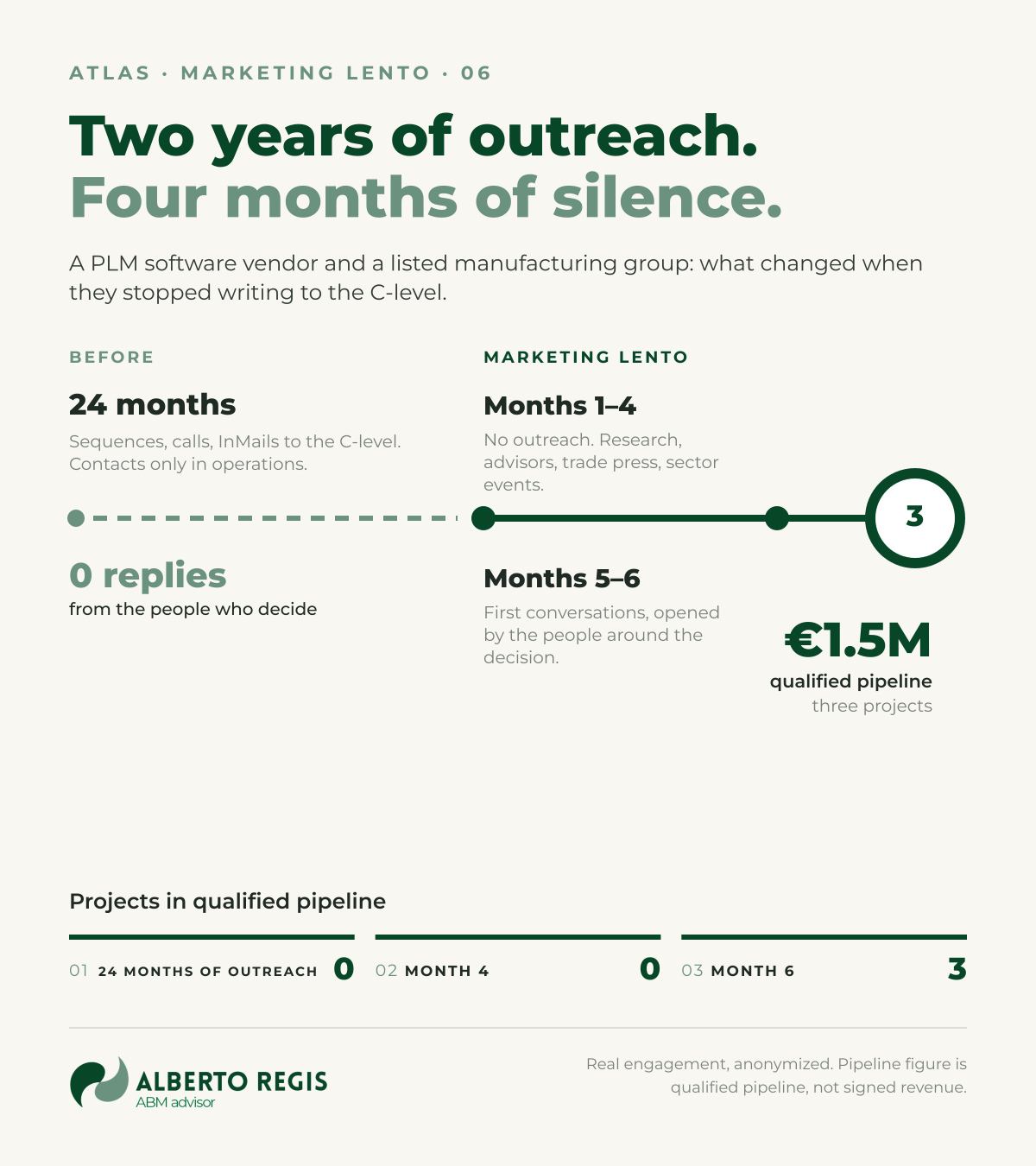
Within six months: €1.5 million of qualified pipeline on three separate projects, two in negotiation and one in formal evaluation. Not because the vendor reached more people, but because, for the first time, it reached the right ones in the right way.
The pattern repeats across the manufacturing programs where this approach has been applied: deep investment in presence, patient distribution of useful thinking through trusted channels, and the discipline to resist faster activity until the system is ready.
8. The Personafication System: the method
Philosophy without method is aspiration. To be repeatable inside companies that still have quarterly targets and limited resources, Marketing Lento needs an operating structure. The Personafication ABM System is that structure: five phases, each a prerequisite for the next.
The name reflects an inversion. Standard practice starts from generic personas and looks for companies that fit them. Personafication starts from the specific account worth sustained investment, and works inward to the real people whose understanding and trust will decide the outcome.
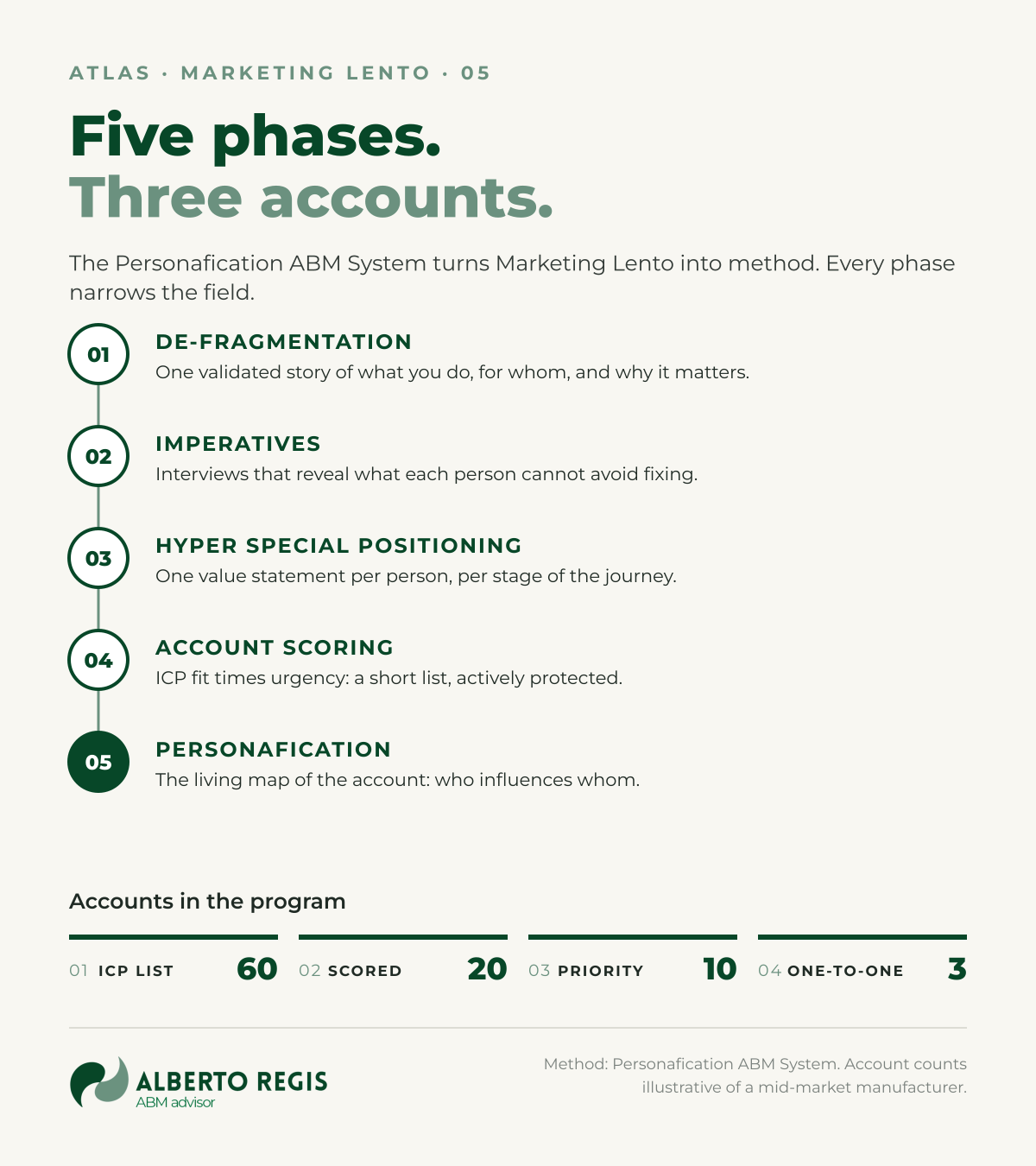
Phase 1: De-Fragmentation
In most Italian manufacturers, marketing describes the company one way, sales another, and operations delivers a third thing. This is not cosmetic. It is a credibility problem. De-Fragmentation produces one validated inventory of what the company really does, for whom, and why it is different: the raw material for everything after.
Phase 2: Imperatives
The intelligence engine of the system. For each real person in each target account, in-depth interviews with comparable decision-makers map their imperatives, their language, their fears and their ambitions at this moment. Qualitative understanding, not demographic approximation or inferred intent.
Phase 3: Hyper Special Positioning
The interviews become a specific value statement for each person at each stage of their journey. The CFO protecting margins, the production director facing new compliance rules, the technical director choosing a platform for the next decade: same company, same solution, different communications, each built on the imperative that matters to its reader.
Phase 4: Account Scoring and Prioritization
A deliberately exclusive filter on two dimensions: ICP fit and urgency, the likelihood that the account is maturing toward a decision within the program's horizon. The result is a short, actively managed list: three to ten accounts for a typical mid-market manufacturer, sometimes one or two for a first program.
Phase 5: Personafication
The continuous mapping work that turns contacts into understanding. Who influences whom, who trusts whom, where informal power sits, who is the champion who builds the internal shortlist (in April Dunford's sense), and what each person knows, or does not yet know, about you. It is Capra's network applied to one account.
Does depth pay? Forrester's 2024 data shows larger deal sizes on ABM accounts in every region: a third of respondents report an uplift of 11–20%, just under a third 21–50%. Buyers who trust you, and believe you understand them, commit to more.
9. How to measure Marketing Lento
The most common objection is not philosophical but evidential. How do you prove the return of an approach whose most important work happens in the dark funnel, a year before revenue, through channels no attribution model traces? It is a fair question, and it deserves a direct answer.
The answer starts with a distinction most dashboards collapse: leading indicators of commercial progress versus the lagging financial outcomes they eventually produce. Marketing Lento does not drop pipeline, conversion or revenue. It says they arrive later, and that the 12 to 24 months before them need their own evidence.
Four leading indicators
- Network penetration. For each account, the share of the people mapped in Phase 5 who now know you and what you stand for. Moving from 10% to 60% of a decision network in eight months is a real change in competitive position, with or without a tender.
- Content resonance. Not impressions, but engagement from inside the account's network. A comment from a senior technical director at a target account is a person spending professional credibility on your thinking. It is worth more than ten thousand anonymous views.
- Dark funnel intelligence. Indirect mentions, peer recommendations, informal references. Hard to collect systematically, which is why most frameworks ignore it. A sales team that records these signals finds the dark funnel is less dark than it looks.
- Relationship velocity. How fast key people move along the ladder below.
- Does not know us
- Has read or engaged with our content
- Recognizes our name and point of view
- Has mentioned us in a peer conversation
- Would put us on an informal shortlist
When a formal evaluation finally opens, conventional pipeline measurement becomes appropriate. The discipline required is attribution: crediting that pipeline to the twelve months of invisible work, not to the month the opportunity appeared in the CRM.
Without that discipline, the organization will keep reading Marketing Lento as slow, instead of seeing results that arrive when the system is ready, and arrive larger.
10. What it asks of the CEO
Marketing Lento asks the CEO for something harder than a budget line or a new tool: a different idea of commercial time, and the courage to protect an investment whose main returns will not show this quarter, perhaps not this year.
That is a cultural challenge. It has to start at the top, because no one else has the authority to sustain it when the quarterly review asks for legible numbers.
The CEO who chooses this path is not choosing uncertainty. They are choosing a different kind of certainty: not a dashboard full of activity while the real work happens out of sight, but the knowledge that when the accounts that matter move, someone in their company is already trusted inside the network.
Three decisions, not a program
- Name three accounts that would change the trajectory of the business if won in the next 24 months. Not the most likely to convert: the most strategic.
- Assign one steward per account. Responsible not for closing, but for understanding: the account's moment, its network, its emerging imperatives.
- Publish one useful piece in the next 30 days on a problem that matters to those three accounts. Not a brochure, not a case study: an honest contribution that asks for nothing.
These three decisions are the start of a different relationship with commercial time. If you are wondering whether the approach fits your company, this short assessment is a reasonable first step.
11. Recovered time: the role of AI
Marketing Lento is not nostalgia for a pre-digital world, and it is not resistance to technology. It is a response to what digital tools have actually done to B2B selling: they have accelerated everything that can be automated, and made rare, and therefore valuable, everything that cannot.
What automation has crowded out is not activity. It is thinking: the slow, contextual work of turning scattered signals about an account into an understanding of what it needs, why now, and which words will reach a specific person.
That thinking needs cognitive space. Twelve parallel campaigns, seventeen accounts in active pipeline and a weekly dashboard review leave none.
The new division of labor
This is where AI enters, and the entry point matters. Applied to account intelligence, AI compresses the preparation Marketing Lento depends on. It can map structures and networks from public sources, watch weak signals across dozens of accounts, and turn scattered research into structured briefs in hours rather than days.
If the time it frees is protected, it buys the scarcest resource in the method: time to think. Time to find the big idea, the one intuition that turns well-researched facts about one person into a message precise and human enough to make them stop and read.
AI compresses the time of research so the professional can expand the time of thinking. Research without thinking is data. Thinking without research is speculation.
That intuition is not an AI output. No prompt produces it reliably. It is a human output, and it needs the unhurried attention Marketing Lento is designed to protect. What no technology will change is the work of caring enough about one person's situation to say something genuinely useful about it.
Open questions
- How can relational depth be measured credibly enough to hold executive commitment through the pre-revenue period?
- How should AI models learn to weigh soft, qualitative signals that precede formal buying activity?
- How do we define return on investment when the most valuable work happens before the buyer admits a need?
- How do we tell the silence of a dark funnel at work from the silence of a program that is not working?
These are not rhetorical questions. They are the practical frontier of the discipline, and the place where practitioners who have absorbed its philosophy will make their most useful contributions.
Three accounts that would change your next two years. If you want to look at them together, start with a short assessment of whether one-to-one ABM fits your company.
Is ABM right for your business?Bibliography
6sense (2024). 2024 B2B Buyer Experience Report. San Francisco: 6sense Research.
Bain & Company (2026). Raising the Odds on a Deal: How Likelihood to Buy Rewires B2B Growth. Boston: Bain & Company.
Capra, F. (1982). The Turning Point. New York: Simon & Schuster.
Capra, F. (1996). The Web of Life. New York: Anchor Books.
Capra, F. (2002). The Hidden Connections. New York: Doubleday.
Capra, F. & Luisi, P.L. (2014). The Systems View of Life. Cambridge: Cambridge University Press.
CEB Marketing Leadership Council & Google (2012). The Digital Evolution in B2B Marketing. Arlington: CEB.
Damasio, A. (1994). Descartes' Error: Emotion, Reason and the Human Brain. New York: Putnam.
Ryan, R.M. & Deci, E.L. (2000). Self-determination theory and the facilitation of intrinsic motivation, social development, and well-being. American Psychologist, 55(1), 68–78.
dentsu (2024). The Superpowers Index 2024. London: dentsu B2B.
Dunford, A. (2019). Obviously Awesome. Toronto: Ambient Press.
Edelman & LinkedIn (2017). B2B Thought Leadership Impact Study. New York: Edelman.
Edelman & LinkedIn (2024). Reaching Beyond the Ready: 2024 B2B Thought Leadership Impact Report. New York: Edelman.
Forrester (2024). The State of Business Buying, 2024. Cambridge, MA: Forrester Research.
Forrester (2024). Account-Based Marketing Results in Larger Average Deal Sizes Across Regions (data snapshot). Cambridge, MA: Forrester Research.
Forrester (2026). The State of Business Buying, 2026. Cambridge, MA: Forrester Research.
Gartner. The B2B Buying Journey. Stamford: Gartner.
Kosfeld, M., Heinrichs, M., Zak, P.J., Fischbacher, U. & Fehr, E. (2005). Oxytocin increases trust in humans. Nature, 435, 673–676.
Miller, J. (2016). The Clear and Complete Guide to Account Based Marketing. Engagio.
Nave, G., Camerer, C. & McCullough, M. (2015). Does oxytocin increase trust in humans? A critical review of research. Perspectives on Psychological Science, 10(6), 772–789.
Regis, A. (2025). Already Decided: How Trust is Built Before the Conversation Begins. Alberto Regis & Partners.
Regis, A. (2025). Se non esisti oggi. Alberto Regis & Partners.
Regis, A. (2026). Before the Signal: ABM, Thought Leadership and the Invisible Buying Journey. Alberto Regis & Partners.
Rizzolatti, G. & Craighero, L. (2004). The mirror-neuron system. Annual Review of Neuroscience, 27, 169–192.
Shamay-Tsoory, S.G., Aharon-Peretz, J. & Perry, D. (2009). Two systems for empathy. Brain, 132(3), 617–627.
Zak, P.J. (2017). The neuroscience of trust. Harvard Business Review, January–February.